Transformation beyond Digital
A lot has happened since then and the truth is that the program has kept evolving and the world has added a few developments worth highlighting:
At the end of 2015 —more than 4 years ago now— I was asked to design an executive program that would dissect the challenges posed by digital transformation. There were hardly any digital transformation programs back then, and IE Business School decided to give me the pleasure of building a program in Executive Education from a blank page. Today we have run 7 editions of #iePDTD and on February 21 we launch the 8th.
Is it possible to understand today's context and the one from 4 years ago in the same way? Could it be that Digital Transformation goes beyond the digital? Is it possible that we need to deconstruct Digital Transformation?
In this POST I want to go over a series of facts and connect a few dots.
"Everything flows, everything changes, nothing remains". -Heraclitus
A lot has happened since then, and the truth is that the program has kept evolving and the world has added a few developments worth highlighting:
1 year before the program was created, in February 2014, Facebook had acquired WhatsApp for 19 billion dollars and Tencent had launched its “Red Envelope WeChat”, transforming the payments space in China. Today Facebook already has more than 2.5 billion users and WeChat Hongbao is approaching 1 billion red envelopes sent.
In February 2016 the eurozone begins a period of negative interbank rates (12-month Euribor) that has lasted until today (almost 4 years). Nothing suggests we won't reach 4 years of negative year-on-year interbank rates, and that points to some uncomfortable outcomes: charging retail customers for their deposits (Sabadell seems to be close) and paying interest on mortgages (Jyske Bank).
AlphaGo, a Google DeepMind product, defeats the Go world champion (Korea's Lee Sedol) in March 2016, a milestone that changed artificial intelligence and deep learning. Is it possible, as Kai-Fu Lee admits, that this was the starting point for China's take-off in Artificial Intelligence?
In May 2016, at Google I/0 2016, Sundar Puchai presents his virtual assistant (the competitor to Alexa and Cortana). Siri's creator, Dag Kittalus, presents VIV that same month at TechCrunch, a virtual assistant that in October of that year would be bought by SAMSUNG and later rebranded as Bixby.
Google opens up the information it holds on each of us with Google My Activity in June 2016. That generous move later becomes an obligation for each and every company. Especially since May 25, 2018 in Europe (GDPR) and from January 1, 2020 in the USA (CCPA).
In June 2016 the UK votes in a referendum to leave the EU (Brexit) and in November 2016 Donald Trump is elected president of the USA. And perhaps we are still not aware of how some Big Tech companies affected the outcome of those elections, until March 2018 when Cambridge Analytica comes to the fore in The Guardian through Carole Cadwalladr.
Salesforce jumps into the advertising world with the acquisition of Krux in October 2016. That same year, in June, Facebook publicly denied using your phone's microphone to personalize advertising and also announced that it was shutting down FBX, its Ad Exchange. Earlier that same year, Google announced the integration of DoubleClick with the entire Google 360 ecosystem and what would be the beginning of Google Marketing Platform. Curiously, that very year, in April, the draft GDPR directive was published [Regulation (EU) 2016/679], to be transposed two years later in May 2018. Privacy and Advertising at odds for the first time?
In March 2017 Uber suspends its self-driving car operations after a crash in Arizona. That same year Waymo announces that it will put its first autonomous taxi on the streets of Phoenix, Arizona. It manages it a few months later, in 2018. In March 2018, UBER has the first fatal accident involving one of its self-driving cars on the streets of Pittsburg. A year later, in February 2019, Daimler and BMW group, two major rivals, announce 5 joint ventures to reinvent the mobility business. Making cars or enabling people's mobility?
Amazon buys Whole Foods for 13.4 billion dollars in June 2017. Can you imagine an ecommerce business built on perishable goods, or have the physical and the virtual merged for the Retail universe?
In January 2018 Google acquires HTC's mobile division for 1.1 billion dollars. Years earlier it had bought Motorola and then sold it to Lenovo. And a year later it would connect the launch of its Pixel 4 to a telecom plan with its virtual mobile operator Google Fi, making it possible to jump between telecom networks instantly. Mobile first, or disrupting the Telcos?
The Cambridge Analytica scandal breaks in The Guardian in March 2018. Although sensitivity around the use of data was already a reality that was not yet a cause for concern, this scandal caused Facebook's user numbers in Europe to fall for the first time in its history. Perhaps it is no coincidence that GDPR had to be transposed on May 25 of that same year. Are we users growing more sensitive about the use of our data, or have the regulators woken up now that elections are being altered?
Facebook launches its Libra cryptocurrency project in June 2019 and a few months later its Facebook Pay service. That same year, in April, Amazon had launched its P2P payments platform in India. Apple had launched its first credit card in August, reaching 32 million users before the year was out. And Tencent dominates transactional payments in China. Could Banking really be disrupted without anyone needing to create a Bank?
A 5 billion dollar fine on Facebook from the FTC (Federal Trade Commission) in July 2019. And the most paradoxical thing about this fine is that Facebook had already provisioned 3 of the 5 billion in the first quarter of 2019.
The leak from Google to NASA and the Financial Times with the first quantum programming exercise and the beginning of what is known as Quantum Supremacy. Is it possible that processing in seconds what would take a computer thousands of years is a change in the way we conceive digital evolution? If we already have access to information (Data), what can happen when processing capacity grows exponentially?
On November 25, 2019, Tim Berners-Lee, creator of the http protocol, launches “Contract for the Web”. A set of principles to guarantee a more utopian future in the digital world. Perhaps they are a compilation of the sustainable development goals for the digital world? digital sustainability?
December 19, 2019, Facebook announces a new mobile operating system (EyeOS) and declares all-out war on Android. Is it possible that the mobile phone, as the gateway to the Internet for half the world's population, is the best tool for building "walled gardens"?
On January 1, 2020, the CCPA - California Consumer Privacy Act (GDPR's American sister) comes into force and Google announces the end of third-party cookies in Chrome by February 2020, which means that solutions applied to data onboarding and to improving digital marketing optimization stop being as attractive as they were in the past (Attribution, DMPs).
And the truth is that all these movements have transformed the way we look at many sub-territories that are part of something bigger: "Understanding how to improve your vision in a disruptive environment of continuous change." To mention just a few of those sub-territories: CEX, AI, ML, Deep Learning, Big Data & Business Analytics, Privacy, Cybersecurity, Digital Decentralization, Marketing Data Technology, Cultural Transformation, Change Management, Data Strategy, Coding, Digital Strategy, Agile and Self-management. If I can do the exercise of bringing it all together into one territory, it would be #Transformation #beyondDigital
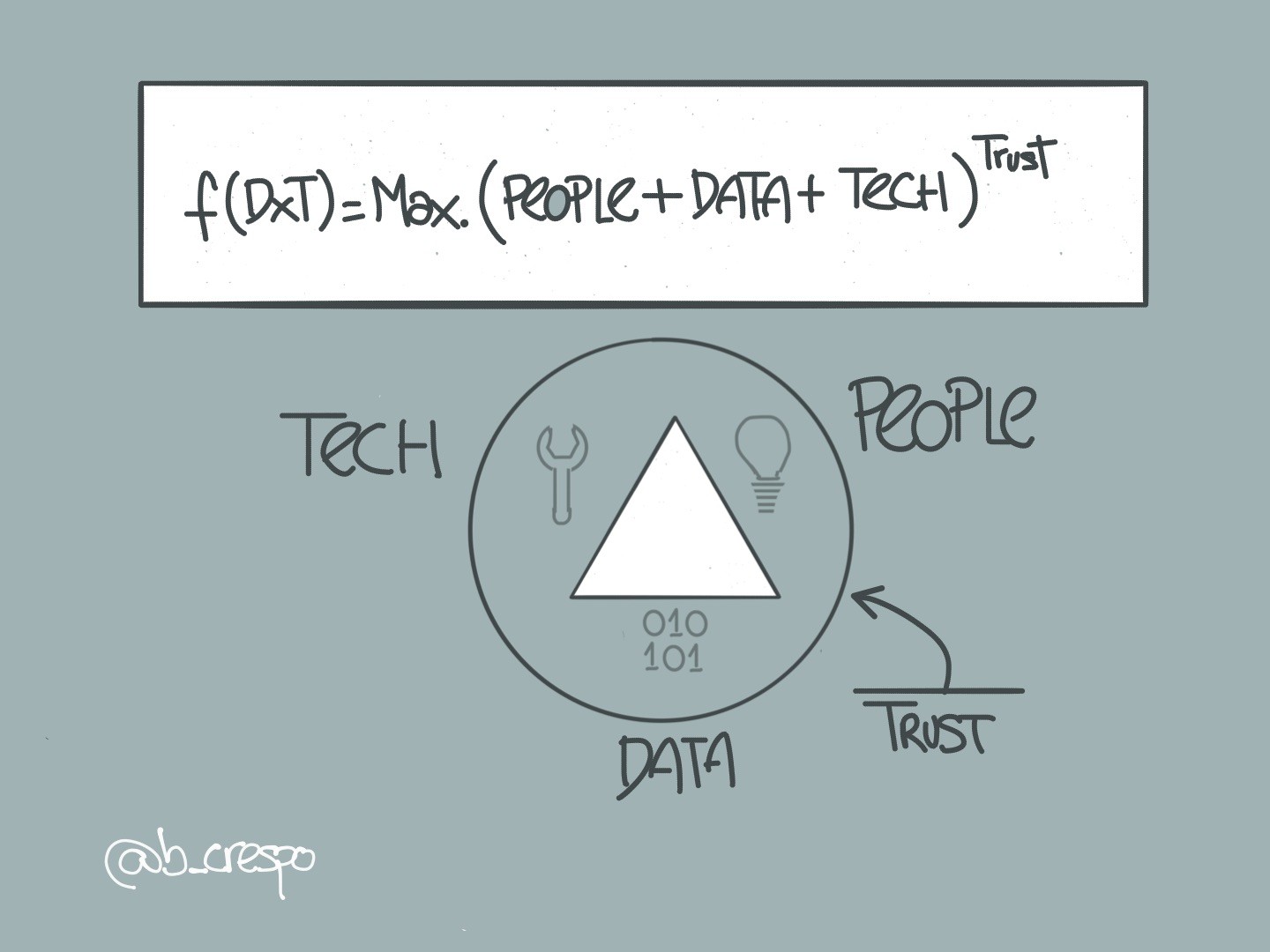
Today the environment has changed and it will keep changing. Perhaps the only thing that stays constant is change, and the only thing left for us is to fine-tune our observer so we can see beyond the news. To learn that the disruption of markets by something we call "digital technologies" or "data" is only possible when people create a vision and execute it using the rest of the "enablers". People, first.
And trust, as the greatest catalyst of a utopian or dystopian future.
On February 21 we launch a new edition at IE Business School of the Programa Executive de Transformación Digital. This POST is an exercise in gratitude to the faculty and to the Executive Education management who make up this learning journey. I have a habit of writing a post for every cohort and I had never done it for anyone beyond the students. This one goes out to you, professors and management of IE Business School Executive Education. This is my tribute.
______________________________________
______________________________________
The author
Bernardo Crespo
C-suite advisor in AI, data and strategy. CEO of Quantum Markethink and Academic Director at IE. He helps leadership teams make sound decisions in the age of AI.
LinkedIn