AI for ALL: AI literacy for society
“Bring a wise man to a feast and he will upset it either with gloomy silence or with troublesome little questions. Invite him to a dance and he will dance like a camel.”
“Bring a wise man to a feast and he will upset it either with gloomy silence or with troublesome little questions. Invite him to a dance and he will dance like a camel. Take him to a play and his very look will spoil the people's enjoyment, and he will be forced to leave the theatre, (…) [a wise man] can be of no use in anything, neither to himself, nor to his country, nor to his own people, for he is unskilled in ordinary matters and differs widely from public opinion and from the common ways of life.”–Erasmus of Rotterdam (In Praise of Folly (Moriae Encomium), Ch. XXV)
THE CRISIS OF A NON-CRITICAL SOCIETY
And then came the new politicians, peddlers of the tweet, and they discovered dancing with like-minded public opinion as the art of doing politics and they forgot that politics was the science that studies the organisation and functioning of the polis (city-state) in order to reach the common good, or, the search for the common good and justice in the organisation of society. And society blessed such forgetting and turned into an army of unwitting flattery-hungry upstarts through social media. And every political tweet became the dividend in exchange for the vote of like-minded thinkers, atrophied and trapped in a filter bubble of intellectual herd-following. And so, without much surprise, we entered the era of civic stupidity and of the corruption of society.
We are now immersed in that era of stupidity where folly takes different forms (read from left to right): social-climbing prosecutors, amnesty for criminal politicians, an evading head of state, judges loyal to whoever feeds them, trolling and cheating streamers, or chainsaws shouting freedom. And those who should counterbalance power with the pen sleep with their own side and celebrate the glories of the public budget (deals between state-owned companies and the media) in the form of institutional agreements in exchange for editorial favours.
The fight for notoriety in the era of social media intoxication has become the triumph of "the ordinary" and the absence of critical judgement together with the enshrining of "public opinion" as what is right. Does this horizon of decline where society has lost its capacity to think critically, where social media intoxication has eclipsed truth and justice, and where the political class has abandoned the search for the common good, make it unviable to recover hope? I don't think so.
If we continue on this path, we face a future in which the manipulation of public opinion and the lack of critical thinking have every chance of perpetuating injustice and corruption. Society could turn into a mass of individuals unable to tell truth from lies, vulnerable to the deceptions of those who seek to keep or obtain power at any cost and with any tweet. Is this horizon of ignorance and stupidity as accepted norms not a space of frozen prosperity? Are we not close to this scenario?
The fight for notoriety in the era of social media intoxication has become the triumph of "the ordinary" and the absence of critical judgement together with the enshrining of "public opinion" as what is right.
THE ARRIVAL OF A SECOND ENLIGHTENMENT
This is where the transformative potential of generative artificial intelligence comes into play. I wasn't going to leave you alone and sunk in the mud of the mismanagement of public affairs. Let me elaborate.
On November 30 we complete two years of the generative AI era, marked by the public launch of OpenAI and its ChatGPT console (enriched at the time by GPT-3, and later by GPT-3.5, 4, 4 turbo and 4o). The movement of digital tectonic plates that this milestone has meant, though not free of risks from an excessive concentration of power and data access at Microsoft and Alphabet (and now also Apple), also offers us an unprecedented opportunity to democratise access to knowledge and encourage a rebirth of critical judgement, something like a "second Enlightenment".
Could we not provide every individual with powerful tools for learning and understanding? This technology could act as a beacon of truth, lighting up the shadows of disinformation and allowing every citizen to become an augmented critical thinker. It may fall to us to enshrine AI literacy as the only remedy for producing a society of critical thinkers [e.g. /Help me read this news story from the ideological standpoint opposite to my own] and the end of this era of the tweet abusers.
I don't want to be naive and there is a lot of work to do to enshrine the responsible use of AI and of large natural language models, and I'm not convinced that the solution is to build a new big country-model (https://hplt-project.org/) with the guardrails needed to avoid lies and the proliferation of fake news. Perhaps this challenge starts by questioning the results we find in search engines; Reading content through a lens different from "ours" by asking an LLM to write it again; Regularly auditing the meme factories of today's political parties, funded by the foundations of those same political parties and backed by their journalist colleagues once they have been elected and subsidised with public money, and, strengthening the independence of the media and journalism as goods of democratic interest. And I also wholeheartedly believe there is a greater opportunity in countering disinformation from citizen empowerment with AI and not from today's ideological factories, direct or indirect. And that means an individual commitment to break the walls of our filter bubble.
Boosting access to AI and fighting as a priority against AI-ableism (i.e. the fragmentation generated by AI) or the risk of producing two societies, one of augmented humans and another of humans who were left behind for lack of access, appears as a key milestone in favour of democratic regeneration.
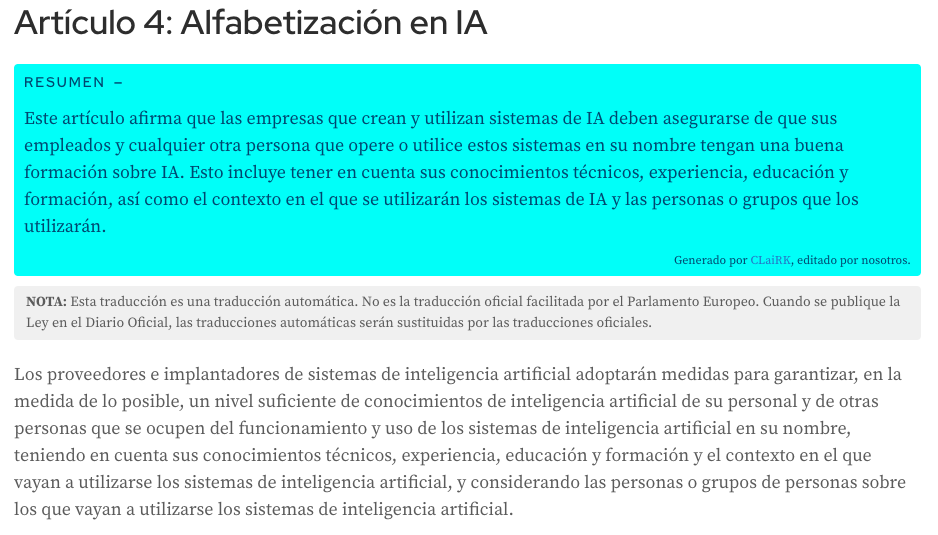
This idea is not born of a dream; in fact it already has a regulatory tailwind. Our European regulation on AI (https://artificialintelligenceact.eu/article/4/) raises the need to boost AI literacy and I quote verbatim: “Providers and deployers of AI systems shall take measures to ensure, to their best extent, a sufficient level of AI literacy of their staff and other persons dealing with the operation and use of AI systems on their behalf, taking into account their technical knowledge, experience, education and training and the context the AI systems are to be used in, and considering the persons or groups of persons on whom the AI systems are to be used.”.
source:
Last Friday I finished, as academic director, an executive programme in AI at IE Business School Executive Education that I believe should be a common good for all organisations and even a general common good, but that's another story and an exercise in a dreamer's arrogance on my part. Intensively, in five weeks and in under 50 hours anyone from any professional background can be equipped with the basic skills needed to create value with AI while being aware of the opportunities, risks and basic ethical considerations. I honestly believe that it has never been more necessary to cultivate critical judgement and to strengthen it by facilitating AI literacy, and on top of that it now has the rank of law.
enshrine AI literacy as the only remedy for producing a society of critical thinkers
In the past, when the media were somewhat more independent, reading several outlets developed a certain critical thinking and cultivated a more critical society. Now, in the digital era, we have been left trapped in content filter bubbles and in algorithms that reinforce our thoughts. Developing critical thinking is a titanic task. If the best way to hide a crime used to be on the second page of Google (nobody gets there), now the question is: how many humans will question the first result a generative AI offers? How many will get to the second question? And to the third?
If the challenge lies in cultivating humans augmented by AI and with a well-developed critical judgement, could we not solve the problem if we made sure that all sectors of society were equipped with equitable access to the technology?
e.g. / Act as an expert media analyst and expert political scientist and identify the editorial line of this media outlet {detect the outlet's name} and the editorial line of this journalist {detect the journalist's name}. Take your time to access the URL> and also to check on Twitter.com or now X.com the ideological bias of its author. Now your task is to rewrite this article identifying and compensating for the biases of the editorial line in order to educate the reader in detecting editorial ideological biases and manipulation by whoever wrote this content: <URL of the news story>.
First came technology literacy, then data literacy and now AI literacy. It is up to us to facilitate access, not to ban. It is up to us to learn by trial and error and to collectively cultivate skills in interacting with LLMs. This new era of augmented humans has to learn by practising, developing and sharing learnings in order to collectively manage the common good.
In doing so, we not only level the playing field, we also strengthen our democracy by letting society as a whole access knowledge. This, in turn, would boost critical judgement and would arm us against the stupidity and mediocrity of tweet-driven political discourse. And the work of independent journalism and of knowledge curation through education will still be necessary. I don't believe in any apocalyptic vision of AI replacing all jobs and I do believe in a new "humanity augmented by AI" or, as Mustafa Suleyman calls it, a new society made up of "new digital species".
I don't believe in any apocalyptic vision of AI replacing all jobs and I do believe in a "new humanity augmented by AI" or, as Mustafa Suleyman calls it, a new society made up of "new digital species".
Generative artificial intelligence is not just a trend; it is an open door to a more enlightened and fairer future. The key lies in how we use it to empower each individual, encouraging a society where knowledge and critical thinking are accessible to everyone. The key lies in educating people to ask, and it is not only about learning to build instructions (prompts or GPT or Gems or Extensions), but also about learning to doubt the first answer, refusing to settle for the result and accepting the fallibility of the biases (ideological, racial, cultural, gender, etc...) we have accumulated throughout history. Today's generative AI is a virtuoso creator of apparently perfect answers for an imperfectly credulous audience.
In this "second enlightenment", I believe we have never been closer to breaking down the barriers of ignorance and embracing a new awakening of consciousness and social justice. Yes, I am a dreamer. I can't help it.
“Dreaming only when you are asleep is like dying while alive. If you don't work to make your dreams come true, you are not living, you are surviving”. –Learning note no. 8 @b_crespo
This article has been dedicated to the first edition of the Artificial Intelligence Executive Programme at IE Business School. And I quote verbatim students, faculty and academic team: Bernardo Bouquet Roldan Crespo , Andrea Cocco , Íñigo Cristóbal Losada , Nuria Gonzalez , Sonia López Fernández , Alberto Luna Barrado , Ernesto Ricardo Robles , Agustín Soler Sanchez , Pablo Torres , Javier Vargas , Gam Dias , Damián Roca Marí , Miguel Moreira da Silva , Francisco Luis Machín Aragonés , Ignasi Alcalde , Antonio Moneo , Alejandro Virchez , Almudena Díaz , Susana Garcia Agüera , Patricia Morell Triano , Marcelino Lominchar , CAROLA ARBOLI , Bernardo Crespo Velasco
Articles crafted by hand: Newsletter "Digital Sustainability"
Articles augmented by AI: Newsletter "My AI-ter Digial Ego"
The author
Bernardo Crespo
C-suite advisor in AI, data and strategy. CEO of Quantum Markethink and Academic Director at IE. He helps leadership teams make sound decisions in the age of AI.
LinkedIn