Why digital can damage your strategy
Trying to frame digital transformation as an exercise in turning your house upside down in order to emulate the best digital player may not make sense for your company.
Digital Isolation may cause | … permanent strategic danger. | … irreversible long-term losses. | … irregular income generation. | ... serious damage to your strategy.
In my view the reflection should be the same before taking on any innovation, where do you want that trend to take you?, do you have a clear route?, have you set a desirable future situation?, or are you just hoping to do it better than that competitor you consider the best in your industry?
This week, on the recommendation of Sergio Maldonado, I spent some time carefully reading a post on HBR.org about the different models of innovation. To put it simply, I'll take the liberty of adapting the reflection on “The Innovation Landscape” that the post contained about the different models of innovation:
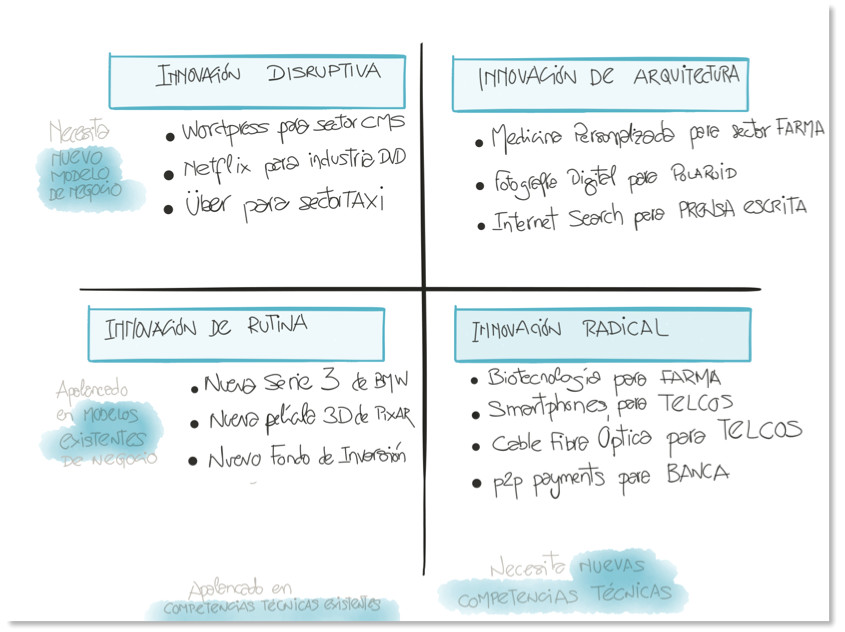
At first glance and from a digital perspective, there seem to be two vectors of risk:
- The vulnerability of your business to the entry of new players more seasoned than you in digital.
- The vulnerability of your business model to the arrival of new technologies that enable the creation of new verticals.
From the standpoint of the passive side of the drawing, if I had to choose a desirable scenario I'd take the first one. And the truth is that the second is easier to conceive of as an opportunity, if you know how to read between the lines. In both cases, what comes up is a scenario of panic for any traditional competitor who isn't managing to read the play. And as we know, panic, paralyses.
If there is one thing I have learned about the possibilities of moving your digital strategy forward it is that everything is based on data, on information. Nothing more and nothing less. If you think that designing a digital strategy that is going to transform your business means venturing into Social Media or pulling down the latest Parallax template to build your website, it seems to me you may be taking on a bit more risk than you should. In a past post on the DIVISADERO.es blog I reflected on the road of digital transformation.
The reflection on innovation models can be a great help in qualifying the digital transformation message. Personally I think it can refine how this message should be integrated into the environment of an organisation where most of the business still comes in through channels that, as things stand today, are not considered digital. And the truth is that being considered digital is doing more harm than good, coming from certain mouths. It is as if a new social stratum were being born: ”the digital ones”. And now they were the ones in charge because only they, know "de qué va la vaina” -what the deal really is, as my Colombian friends would say.
I think that taking on the challenge of digital transformation is an exercise in restraint and humility. And even though it may be revolutionary in the changes it brings to your business over the next 5 years, digitalisation is still one more enabler. One of the axes of innovation. The other is your business model.
It may be that entire verticals have fallen as a result of the arrival of new value propositions, 100% digital natives. And this is no obstacle to reflecting on how important digital is for your business, and on how this transformation should be fitted in alongside your profitability model and your technological capabilities as of today.
No, this is not a message to hit the brakes and throw it in reverse. The change has already happened. Now all it takes is restraint to integrate all the information and humility to define the scope of the possibilities a digital strategy offers your business. I'm reminded now of a familiar image from the Three Kings parades. And children know a lot about this:”Be careful about opening your hands to grab more sweets, because they may all end up falling on the floor”.
If you are one of those companies whose revenue is heavily leveraged on traditional sales models, I invite you to make the following reflections before falling into digital isolation and losing your place in the line because you bent down to pick up a sweet. Here goes my invitation to reflect:
… What is your starting situation and what are the risks of your business model falling apart because of the arrival of new purely digital players?, Is it possible that your business model is condemned never to be digital? I don't think so, and you may have years of diminishing returns ahead of you before a new competitive scenario starts to take shape. That new scenario may require a change in the current business model, and that change may be brought about by some of your current sources of differentiation. More than a decade ago this exercise was already called exploring “the edges of your business”. The risk of your model being affected by some collaborative initiative is undoubtedly a reality for any industry. Today, a handful of users keen to cut out intermediation costs can break an entire industry -just ask taxi drivers. And you may still be far from that situation.
…What use are you making of the data on your users' interactions with all your digital touchpoints?. This is not negotiable. Any small digital-native competitor ALREADY measures every last interaction users have with its website, its app, emailings, social media profiles, and it can even measure apparently non-digital behaviours. If you don't yet know how to do this job, surround yourself with those who do. And you probably don't need to have all the information your current information system requires available right now. And it is probably worth first making progress on polishing the digital data and then working on integrating it with your traditional information systems. Waiting until the data is completely fine-tuned at your current pace can cost you more than 1 year. 1 year! There are more than 100k videos watched on Youtube in 1 second, more than twice as many searches on Google in that same second. Are you willing to spend 12 months? Take a look at this page and your conception of time, will change (http://www.internetlivestats.com/).
… What are the foundations on which you have built your business's differentiation within your vertical so far?, Is it possible to move forward by using the new wealth of information that comes from being able to trace all your potential or future users? Your industry may not yet have started down the road of digital transformation in any widespread way, and to read that signal you only have to look at how your customers decide. They are the engine of change, not your competitors. If your thing was price, that differentiation may already have fallen away if you haven't positioned yourself yet. Your bases of differentiation may lie in your physical distribution model, and perhaps that is the first lever to activate in digital. As things stand today, can you help your traditional sales teams with the information users leave on your digital assets?
… What are the bases of differentiation of those digital-native businesses in your vertical?, were they created by them or did they occupy a space you failed to occupy in time?, do you know how to measure who is who in digital?, do you have the distinctions to analyse every source of differentiation in the digital environment? Again, ask for help if the answer isn't yes. It may be that the most routine innovation in digital is the basis of differentiation of those new competitors in your sector. And that innovation is based on making the most of the power of data to make the user experience more personalised and the business's learning curve steeper.
Bringing digital intelligence and digital transformation together should in my view be one of your priorities as a traditional business leading your vertical. Knowing how to weigh the “pros" and “cons" of taking on a complete transformation of your business in order to bring in new digital disciplines is a priority task. Taking on the complete transformation right now may involve more risks than opportunities. Perhaps your way of approaching the challenge is closer to creating “plots of digital transformation” as @ron_miller recommends in his TechCrunch post.
And now the question is "How far down the rabbit hole do you want to go?”, how deep into this digital transformation business are you willing to venture?
If you sit and wait you may lose your place, if you break into a run you may lose your way. Setting off is the only option.
This post was originally published on my blog.
About me:
Bernardo Crespo is Digital Transformation Leader at Divisadero.
Director of the Executive Program in Digital Transformation at IE Business School and an Ontological Coach certified by Newfield Network in Bogotá (Colombia).
Bachelor's degree in Business Studies from UCLM and final year of a BA Honours in Management and Economics, University of St Andrews. Executive Master's in Relationship Marketing, CRM and E-Commerce from ICEMD and a teacher at several business schools in Spain. Worked as digital marketing director at BBVA España.
I currently help companies walk the path of Digital Transformation at DIVISADERO.
The author
Bernardo Crespo
C-suite advisor in AI, data and strategy. CEO of Quantum Markethink and Academic Director at IE. He helps leadership teams make sound decisions in the age of AI.
LinkedIn