VUCAneers, digital omnivores and other variants of herpetologists
Anyone who hasn't heard of the term VUCA has read little about the digital economy, strategy or digital transformation, or has perhaps preferred to stick…
Anyone who hasn't heard of the term VUCA has read little about the digital economy, strategy or digital transformation, or has perhaps preferred to stick with the acronym in its Spanish version. Digital is something that has changed the world and that is destined to be biodegradable. And perhaps it should serve as food for all of us: “Digital omnivores”. The challenge now lies in continuing to cultivate the courage to be curious. And that requires facing some fears.
In a talk by David Kelley that is part of the TED classics, in which he develops the concept of Creative Confidence -the ability to recover confidence in our capacity to create- some of the gems appear that make all of us understand what the learning process is for any skill we judge to be beyond our reach. Is it possible to be a digital leader in an already digitalised environment?
Perhaps it makes no sense for someone to talk to us about leadership, vulnerability, collaboration alongside technological concepts such as artificial intelligence, deep learning, data lakes or mobility. And everything is mixed together. Not everything digital is technology, and neither is it possible to learn without the right attitude. An old Zen proverb holds that the master appears only when the disciple is ready. Understanding the keys to governing the digital transformation of companies requires high doses of observation, the methodology of an archaeologist, the capacity for empathy of a mother, the courage of a pirate, and the appetite of a bear waking up in spring. Go back over the metaphors and it will make sense to you.
Digital is something that has changed the world and that is destined to be biodegradable. And perhaps it should serve as food for all of us: “Digital omnivores”.
The digital leader we are looking for has many names for an executive search consultant: Chief Digital Officer, Digital Transformation Officer, Chief Marketing Technology Officer, etc. And none of those names resolves some of the basic capabilities of this position. That is quite possibly where the gap lies between the competences required and the skills needed. Most CDO (chief digital officer) search processes suffer from the projection of past frustrations on the part of the company's management, or simply from the CEO's shortcomings. It isn't possible to find the person we are looking for if the challenge is badly framed. And there is also the risk of falling into CDO-stasis, and that is part of another conversation. Training top-level professionals to lead digital transformation processes requires, as a first step, folks -women and men- who already have the mileage, and who have given themselves permission to learn again. If you think you already know, you are not called to lead the change. #headhunting #CDOsearch
Digital Learning and Leadership Experiences
What is the difference between a digital learning process and an exercise in sharing leadership experiences? Perhaps nothing, in an era in which everything is mixed together. Being digital today is like wanting to be medieval before the renaissance. You already are. You just have to give yourself permission. And it may help you to pass on to your organisation and to yourself some of the following maxims:
- Redefining the business model is something you build while making the “core” part of your P&L shine. The part you call non-digital. And which can also be digitalised.
- Moving forward with your new business model carrying the same legacy of organisational definition is a task for titans. Drop that heavy backpack. Making the structure flatter doesn't call for a night of the long knives, and there may be a casualty.
- An organisation doesn't get digitalised by hiring a CDO and letting them walk the path alone. There may be organisations looking for an icebreaker CDO or for infantry. Some of you already know what I mean. Maybe the challenge appeals to you. I still consider this to be a team exercise.
- Governing in environments of uncertainty requires a certain touch of madness. Look at the ones who are already mad in your organisation (intrapreneurs); maybe that is where the seed of your transformation lies for covering the first phase.
- Learning from others is possible and learning is only embedded by doing. Try it. And once you are trying, document your own process, because that methodology conceals the slope of your growth curve.
- If you don't like technology, data and even less so people. Things look bad. If you think you can lead on your own. Things look worse. If you read agile as a synonym for fast. That's not going well either. If you think transforming your company means making the P&L more efficient, you are only seeing a small slice of the pie. Open up your gaze and don't expect to have all the answers.
- And now start walking. And have the courage to define your desirable future situation. And discover that crystallising all the learnings in the first project is an exercise in arrogance. You will only have control when you feel, in your gut, that the anxiety to know has gone and you can still see that there isn't time to read everything you have left to read. Anxiety about carrying on learning? Enjoy the humility of carrying on learning.
The secret of growing in digital competences when you have a whole professional life of internalised learnings behind you is an exercise in mastery. And someone can be guided through this process (guided mastery). And it is closely related to the appetite for consuming digital content (digital omnivores), the discernment to bridge old and new thinking (connecting the dots), and the courage to venture into a space of insecurity (#VUCAneers). This process has a lot to do with learning to love snakes (herpetology).
The process of loving snakes
This is not about making a case for facing your fears and it certainly is the only route all professionals have today to transcend that barrier separating them from understanding that digital transformation is a leap into a reality that already exists and in which you never gave yourself permission to take part. A lack of narrative? Possibly a phobia of making mistakes.
In the talk by David Kelley, co-founder of the consultancy IDEO and Design Thinking professor at Stanford, which I mentioned at the beginning of this post, the author shared his own learning experience with a concept called “guided mastery”, or the process of reaching mastery with assistance. In his example of Doctor Bandura as a successful psychologist in the treatment of phobias, Kelley tells us that success lies in the support and guidance and above all in the effectiveness of each one of us in taking the final step “self-efficacy” or simply courage? Behind this concept there is nothing more than the exercise of guiding and empowering a human being towards unknown territory, a space where the most irrational fears appear. This is where our snakes appear.
https://youtu.be/16p9YRF0l-g | How to build your creative confidence | David Kelley
I have been lucky enough to live through more than a hundred interviews with extraordinary professionals who are considering leading the digital transformation of their companies in a space full of freaks, geeks and other characters with self-declared digital speed. The line from my friend Nacho Jiménez Soler “In digital, plenty of people wear a faster face than the speed they are actually doing” perfectly captures that being digital isn't about changing the egg on your Twitter account. Even though the egg already died in April this year.
Leading digital transformation is a process that begins with the personal courage to give yourself permission to learn again. And that means revisiting the codes on which the confidence in your own narrative has been founded to date. It is the only possible path in a space of change #Livelong_learning
This week I wrapped up my work with the second cohort of the Management Programme in Digital Transformation at IE Business School, a group of brilliant professionals in their learning process, or “guided mastery”. And it is right now that it is crystal clear to me that they already knew the way and that someone at some moment in their lives told them that being digital was something complex. Perhaps nobody told them and they interpreted it that way. And the truth is that nobody is digital and nobody is analogue. Nobody IS, we are all BECOMING, in a continuous process of change. And right now the pace of change is greater than at any other moment in history. Perhaps this is the key to learning the short life of our failures. Our successes are perishable too. It is all a question of the observer.
The only thing that remains eternal until you decide to challenge it is your own fears. They will always go with you until you decide to transcend them. And yes, snakes exist and it is also possible to discover their beauty; all it takes is getting to stroke them. And that may require someone playing a facilitating role.
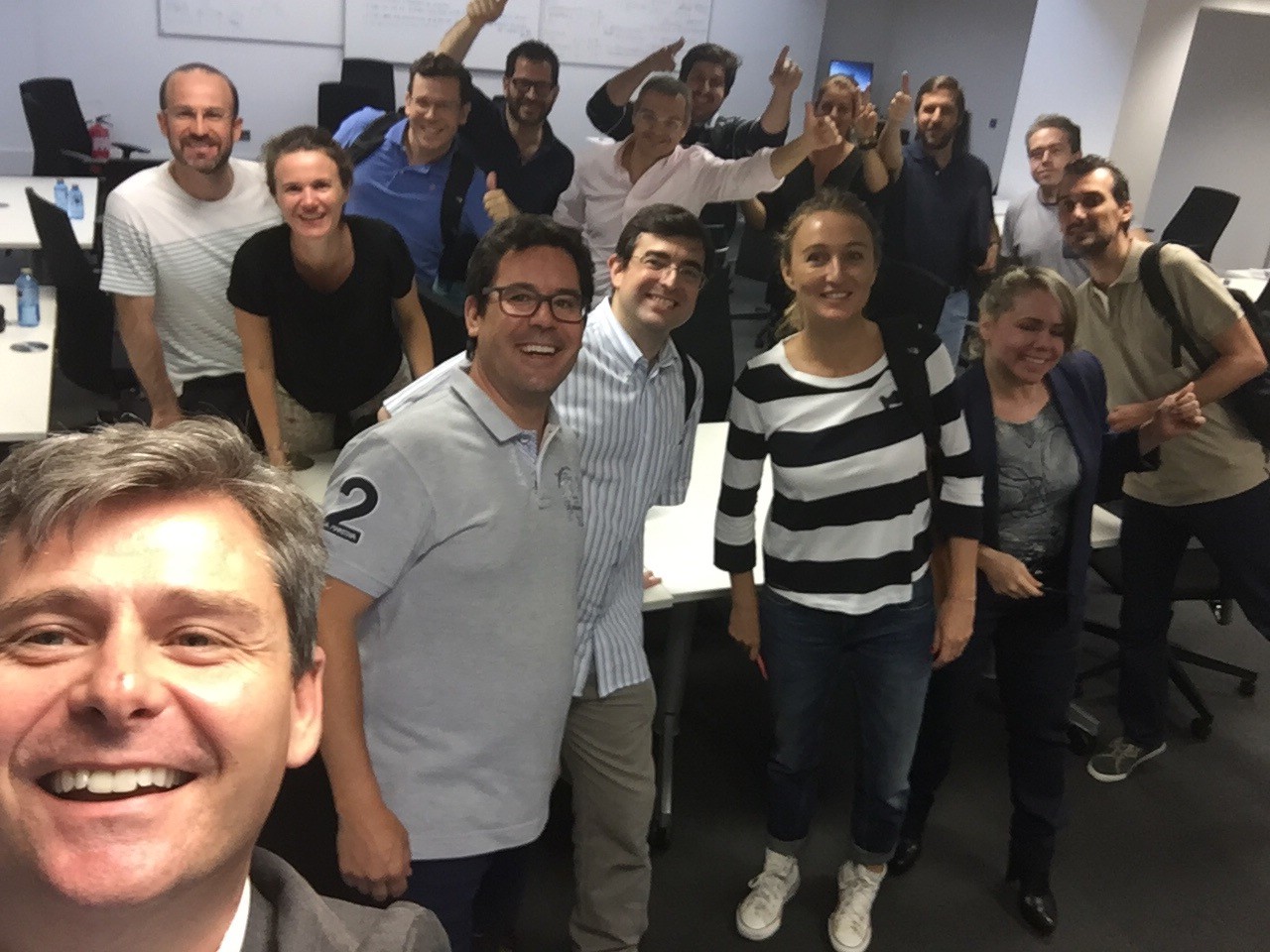
Dedicated to the students of the II cohort of this programme, who have made me learn concepts such as VUCAneers, digital omnivores and others I don't dare quote. They are already snake lovers. It has been a pleasure to live through this process with you. #WeAreONe
[Ignacio Aparicio, Belén Caínzos, Marcos Carrera, Iñigo de Juan, Stéphanie Dubourthoumieu, Andrea Fabra, Pablo Emilio Fernández, Luis María González, Javier David López, Juan Manuel Penín, Ramón Puga, Raúl Retamosa, Francisco Javier Serrano, Pablo Soneira, José Antonio Vega, Nancy A. Vega, Gustavo Vivancos, Rodrigo Weber]
The author
Bernardo Crespo
C-suite advisor in AI, data and strategy. CEO of Quantum Markethink and Academic Director at IE. He helps leadership teams make sound decisions in the age of AI.
LinkedIn