The Challenges of Senior Leadership in Digital Transformation
[See POST on blog @b_crespo QUANTUM MARKETHINK]
Cultural transformation, leadership, vision and strategy, courage, humility, technology as an enabler, curiosity, consistency and the will to learn. These challenges are also common to the whole C-suite, not only to the CDO role.
[See POST on blog @b_crespo QUANTUM MARKETHINK]
If every time we did the exercise of sharing a round table or a debate the chance came up to produce written content in real time, everything would be more boring. Flannery O'Connor said that I write because I don't know what I think until I read what I say. This post is an exercise in sharing reflections out loud and, along the way, in sharing the learnings I take away from having shared a panel with valuable people. A tribute to those of you who couldn't be there.
“I write because I don't know what I think until I read what I say.” - Flannery O'Connor
Thank you Miguel Zancajo, Luis Carvajal and Mosiri Cabezas for making a space for reflection and dissent so easy. I had fun talking with you. Thank you from the heart for the learnings. And thank you Silvia Dvorak for making this space possible and for your initiative, the IE Alumni Advanced HR Club. This panel on "The Challenges of Senior Leadership in Digital Transformation" would not have been possible without you.
Susana Rodríguez Urgel, co-director of the Executive Program in Digital Transformation at IE Business School, wrote down as a summary the following exercise in the form of a list of takeaways:
- Culture (courage, humility)
- Technology (resources)
- Leadership (motivation)
- Urgency
- Vision (the ability to ask good questions)
- Trust as the base stock
- Structure (collaborative)
- Common sense
- Attitude
And since I can't bring myself to leave a list of nine points without a tenth, in the same way we close a wardrobe before going to bed or go back to the car to check whether it's locked (when we don't have an app that warns us we forgot), here goes a reflection by way of a tenth point or "Ingredients of Senior Leadership for Digital Transformation".
C-LEVEL INGREDIENTS FOR DIGITAL TRANSFORMATION
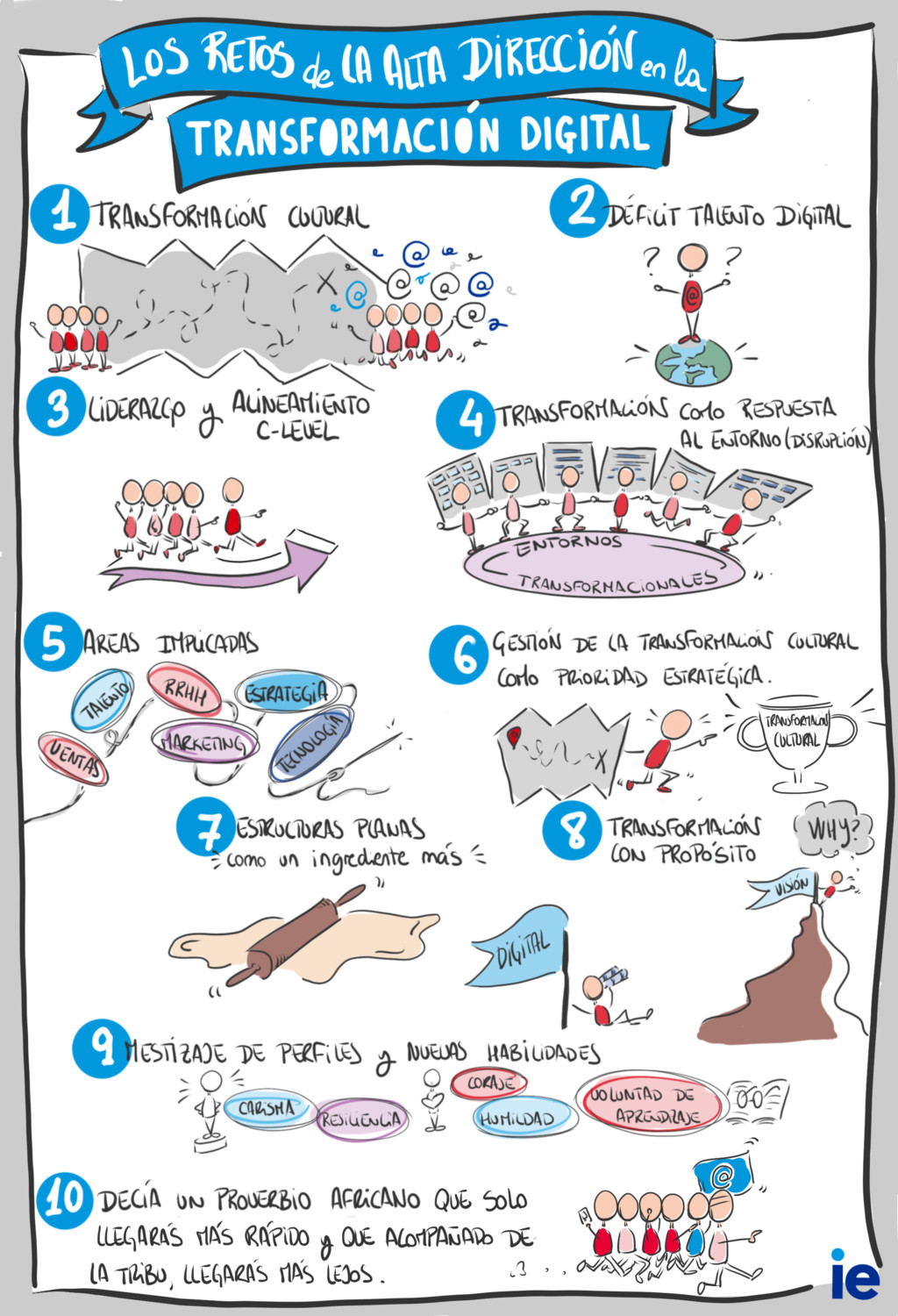
Cultural transformation appears as the challenge to solve and the one we are all perhaps leaving as a second-priority task in a company's digital transformation process. Miguel Zancajo acknowledged that the real engine of transformation is people (customers and employees) and put on the table the need to bring internal talent to the surface as the engine of cultural change.
There is still a deficit of digital talent and it is possible that the positions most recognized as change managers -CDOs, have plateaued in terms of hiring demand in absolute numbers. Even so, it remains necessary to bring in talent "touched" by digital and enriched with the so-called soft skills in order to manage the most transformational part of the change: the creation of business models that guarantee the next generation of revenue in the P&L. Perhaps we need to ask new questions in order to glimpse the real transformation. Luis Carvajal recalled the Pablo Picasso quote "Computers are useless because they only give us answers. The value is in the questions."
The most valuable part of the challenge of transforming a company is still the leadership and the substance of the profiles that start the change. The rest is an exercise in teaching that has to seep through the whole organization. Mosiri acknowledged that a single person cannot work the change alone, and that, without their initial push and leadership, nothing will have changed. That leadership contains classic recipes that make a "back to the basics" in the ingredients of whoever leads the transformation more advisable than ever.
Few organizations have decided to transform intuitively. Most do it driven by agents of disruption. We cannot recognize digital transformation in companies that were born transformed. The real challenge lies in creating transformational environments that break with the traditional business model. Any other exercise is adapting -Luis Carvajal pointed out- to a change brought about by the customers, who are the ones that have truly already transformed. Is digital transformation a concept born out of fear?
Is digital transformation a concept born out of fear?
Creating flat structures at the organizational level is nothing more than one additional ingredient of the transformation process and we cannot credit the success of a transformational process to creating more horizontal structures while giving up the advantages of a hierarchical model. We run the risk of lightening verticality and letting the weight of decision-making fall on the teams, if we do away with reporting levels in organizations -Miguel Zancajo acknowledged.
Talent and Human Resources as the manager of cultural transformation, business development areas as the guarantors of the P&L and technology areas as enablers, are the drivers of digital transformation. And there is always a primary role in defining the vision: Strategic Management? And all the top levels working collaboratively are responsible for the transformation of companies. And perhaps substance and consistency are a more valuable ingredient than ever.
Leadership, strategic definition and the management of cultural transformation appear as the pillars of a digital transformation process. And there are no standard recipes. Each model requires an ad hoc approach. And the leadership and consistency of the organization's top level is the only guarantor of a culture in which silos remain the great obstacle to resolve. Even if sometimes the silos are the key -Luis Carvajal disagreed- when it is time to push the current business model (exploit) and at the same time grow the handover in the P&L (explore).
"Leadership, strategic definition and the management of cultural transformation appear as the pillars of a digital transformation process."
Any transformation exercise requires a basic and deep reflection on the organization's new purpose. Here the WHY appears as the challenge to face as a priority (Thank you Ramón Puga for the clarification). Luis subtly called on us to go back to the reflection Why, How & What.
A blend of profiles and new competencies is needed, and with digital competencies or technology alone it is not possible to transform a company. It is not a question of age or professional background; charisma, "resilience", courage, humility and the will to learn appear as key skills. We are talking about a "back to the basics" in skills -Mosiri Cabezas argued.
The African proverb said it: if you want to go fast, go alone; if you want to go far, go together. Perhaps we are not discovering anything, and it seems that the challenge of digital transformation requires leaders. A leader's role is still to glimpse the desirable future and to be generators of great teams that know how to execute the path, that vision. Nothing new. And it still needs saying.
SUMMARY INFOGRAPHIC:
The author
Bernardo Crespo
C-suite advisor in AI, data and strategy. CEO of Quantum Markethink and Academic Director at IE. He helps leadership teams make sound decisions in the age of AI.
LinkedIn