More Wood on the Fire: The Risk of Cognitive Offloading
“Humanity has never moved forward without friction. The question is: how much friction is enough not to pull us off our centre and to keep our north star…
“Humanity has never moved forward without friction. The question is: how much friction is enough not to pull us off our centre and to keep our north star?”
In the Industrial Revolution, the demand for coal and wood was insatiable: more factories, more production, more energy. Today we are living the same frenzy, but in a digital key: more GPUs, more models, more artificial intelligence (God DeepSeek willing). Generative AI has taken the world by storm and, in barely two years, we have witnessed an exponential explosion in its processing and application capacity.
If we tried to represent this evolution of generative AI with language it would not be easy at all. It would be something close to devising a literary figure capable of emulating the epic heights of an exponential function in mathematics. How do you use language to represent an exponential function? Going from a series of adjectives to a superlative? A string of superlative adjectives? Surprising, tremendous, mind-blowing, astonishing, incredible… And each new model outdoes the previous one with a brutality that defies any comparison. There is no language to express the exponential change in time and in problem-solving of foundation models over the last two years and a bit.
But how far can this brakeless train go?
“Revolutions do not ask whether you are ready; they simply go off"
Two Years of Generative AI: How has it changed my life?
Barely 24 months ago, generative AI was a fascinating toy, an intriguing assistant. Today it is a strategic partner in my daily life.
Research and discovery: What used to take hours of reading and analysis is now a matter of minutes (I still need to read). I do not need to search, filter, cross-check; AI does it for me. And although I remain critical of the result, sometimes that is harder. Sam Altman says that the babies being born now will already take it for granted that AI has surpassed them cognitively.
Saving time with agents: I automate emails, schedule meetings, generate reports. AI agents almost work while I sleep. And this is literal when it comes to researching, composing, sharing.
Writing, coming up with ideas, creating projects: From brainstorming to drafting; from synthesis to development; from transcription to complex calculation; from ideation to generating complete projects including a business model canvas. AI boosts my creativity further than I could ever have imagined. But at what cost? Later we will look at the recommended limits
Even cooking or working out: Today, AI suggests recipes with whatever is in the fridge and designs personalised gym routines. Soon, absolute automation will free us from trivial decisions such as choosing what to buy or which service provider to hire (phone, electricity, banking, etc.).
It is convenient, yes. But also unsettling. Because when you delegate so much, what is left for you to do?
“If you hand AI the reins of your life, do not be surprised if one day you do not know who is driving it.”
The Future: Humans asking, Agents answering
Imagine a future where the user interface changes radically: we no longer browse an Internet of text, images and video, but an ecosystem where agents converse with agents. An enormous ocean of tokens grouped by characters, ideas and thought constructs generated by users' affinities and dislikes or by the spurious interests of whoever designed the model:
We buy products without comparing, because AI already knows what we want.
We switch electricity provider without noticing, because another agent made the best decision for us.
They pick the best "match" as a partner for us, but do we really interact?
If this drift sounds familiar, it is because we have seen it before in WALL-E: dependent humans, digitally obese and cognitively stunted, assisted by agents that do everything for them. Managed, I would even say.
And in less than five years, we will go from being intelligent humans, to augmented humans… and then, to managed humans.
“First we delegate tasks. Then we delegate decisions. When will we delegate our identity?”
I do not want to be pessimistic. Optimism sells, pessimism scares people off. But there is something undeniable: we will think less and less and delegate more and more.
Even though we declare that positive news appeals to us, the reality is that we consume digital toxicity like addicts. Spend five minutes on X (Twitter), then five on BlueSky, and you will see how toxic emotionality has hijacked our minds. Give BlueSky time and it will become similar. Everything has filled up with short videos where the instant intake of visual emotion replaces the reflection of a good read.
In short, we reflect less, we react more.
AI is not only changing how we work, but how we eat, think, feel and decide. Are we not what we eat and what we think? The danger is not that AI replaces us, but that it makes us forget who we were without it.
If René Descartes could raise his head (“Cogito ergo sum”) he would be astounded by the existential emptiness we are drifting into as if it were the natural outcome.
The Threshold of Cognitive Offloading: Evolution or a Limit on Degeneration?
The key question: what happens when cognitive offloading hits our creativity? If we systematically delegate creative tasks to AI, will we lose the ability to innovate on our own? If we always ask for answers, do we stop telling truth from falsehood?, have we been educated to formulate questions as much as to find answers?; If we use generative solutions for everything, is our ability to collaborate with other humans wiped out? Critical thinking, creativity, collaboration, communication, curiosity, systems thinking, curiosity. There was a set of skills that made us unique, are they at risk?
Mustafa Suleyman defines AI as a new digital species, a “digital companion”. And I am glad that it is so and that we are the ones defining the limits of our companion. AI is a tool. Have we not already felt at some point the temptation for the tool to become our teacher in some domains? Yes, I am talking about skills that are necessary and non-negotiable in the age of AI.
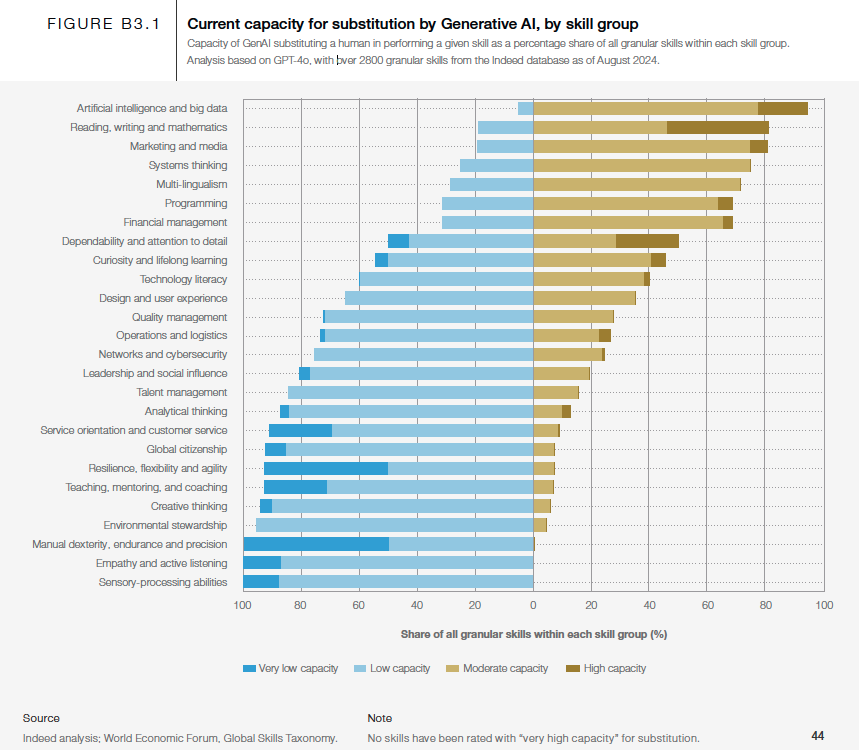
The following image “Current capacity for substitution by generative AI, by skill group” is taken from the report The Future of Jobs Report 2025 - WEF. It shows clearly and simply how some human skills are in danger of being replaced or substituted.
I will not be exhaustive. I will let your curiosity run. Just a few notes:
AI and Big Data: It is funny how AI is conquering its own home turf. It analyses data with surgical precision and generates simple predictive models.
Programming: It used to be an advantage, now AI generates code better and faster. And perhaps that is why we are all starting to develop our abstract thinking more than ever. And not all of us.
Marketing and media: Text, images, videos in seconds. Those who generate content are already augmented human beings. Content generates itself. I remember a conversation with a media outlet in March 2022, using GPT-3 at the time through you.com, and we were thinking out loud about creating a synthetic copywriter. Today it seems comical because reality has overtaken a hypothetical projection.
Finance and quality: Pattern identification, risk prediction. Building drafts of financial statements. The masters of efficiency will be the first to make themselves efficient too. There is something funny about that.
There is no doubt that we are at the threshold of a humanity in transformation. We must reflect on the impact of new skills and on the talent acquisition strategy in this era of augmented skills.
Cognitive Offloading: AI, the Paradox of Our Era
And what is the projection several generations from now using AI on a daily basis? Are we shrinking our brain? (see header image) Yes, there is already a name for it: cognitive offloading. Cognitive offloading saves us time, but it steals our critical thinking. If we stop training memory and problem-solving, what do we turn into? Using AI as an ally is progress. Using it as a crutch is intellectual suicide. The augmented obese and the cognitively stunted.
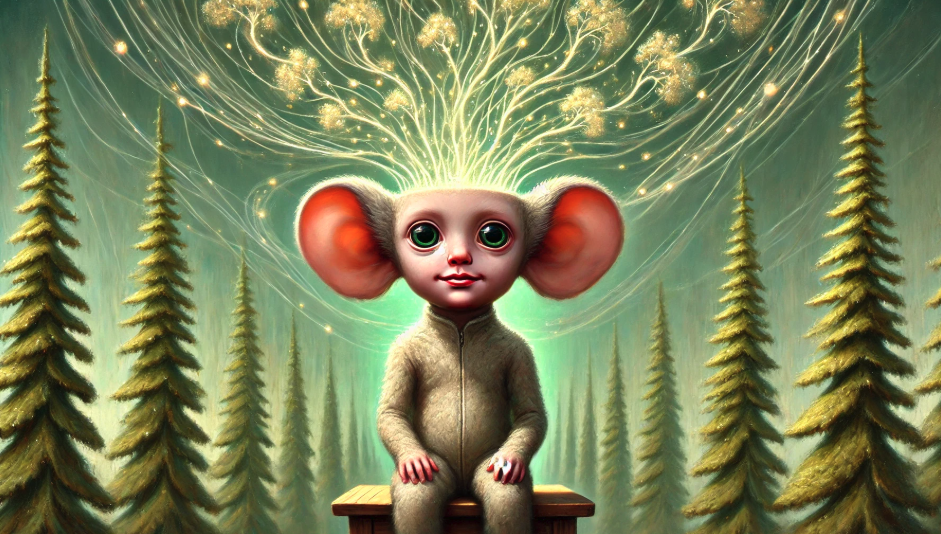
Image generated with AI
Thanks to AI I am better today. But if I systematically rely only on AI, I run the risk of degenerating into a stupidity fully aware of its own existence. From augmented humans to augmented global foolishness. We are not far from that situation, looking at the new kind of leadership emerging in the latest political elections. That is why the key is not in rejecting it, but in using it consciously. In setting unplugged breaks and balancing its use with our natural ability to think, create and decide. Soon we will carry on talking about unplugged breaks (and this is another project I will share another time) and right now we are talking about cognitive offloading and basic skills.
I think that deliberately planning cognitive practice as a kind of mental gymnastics and immersing yourself in the darkness of the absence of AI should perhaps become a recurring practice for all humans who use AI intensively in their day-to-day. Questioning, analysing and distrusting a random press article. Not settling for the first search, imagining what would happen if what I consider impossible turned out to be possible. Building with other humans, less individual work and more humans involved in collective creation up front. Perhaps our own solitude afterwards will do the rest. Learning to build patterns of composition, how to convey, persuade and connect without depending on the mediation of a machine. Keeping the ability to explore and not looking for instant answers. Questions and more questions, seas of questions. Understanding the complexity of the world and the uncertainty of unexpected behaviour. I do not believe everything can be reduced to simple predictive patterns.
I remember a series of reflections I created in a flash of lucidity a decade ago and one in particular that said “Our mind works like night vision, it becomes lucid when it patiently observes the darkness” (Learning note no. 33).Perhaps it is our turn to observe the darkness of a reality without AI from time to time as a necessary step to recover cognitive sanity. If we do not, we will go from being intelligent humans, to augmented humans, and finally… to managed humans. I insist, The augmented obese and the cognitively stunted.
“Our mind works like night vision, it becomes lucid when it patiently observes the darkness” Learning note no. 33
Dedicated to Elías Gómez. With all my affection wherever you are. We will miss your kindness.
Bernardo Crespo is a seasoned digital transformation and data strategy leader with over 25 years of experience. He has held leadership positions in Fortune 500 companies and digital consultancies, and has founded and advised numerous startups and venture builders. Currently, as CEO of his own firm, Quantum Markethink, he provides strategic guidance to C-suite executives, helping them navigate the complexities of digital transformation.
Furthermore, he serves as an Academic Director at IE Executive Education, where he brings his expertise in emerging technologies, digital strategy, data strategy, and artificial intelligence to the classroom. Prior to these roles, he spearheaded digital transformation initiatives at Merkle Spain and led digital marketing at BBVA, where he notably pioneered the application of gamification in banking.
Bernardo is also the co-author, with Gam Dias, of "The Data Mindset Playbook: A Book about Data for People Who Don't Feel Like Reading about Data" (KDP, March 2023).
Articles augmented by AI: Newsletter "My AI-ter Digial Ego"
Articles 100% crafted by a human: Newsletter "Digital Sustainability"
The author
Bernardo Crespo
C-suite advisor in AI, data and strategy. CEO of Quantum Markethink and Academic Director at IE. He helps leadership teams make sound decisions in the age of AI.
LinkedIn