Is Digital Conversation the New Black?
This is a reflection on a digital paradigm shift: Conversation as the new user interface. From websites to apps and now: "conversational UI". An exercise in reflection on the challenges and opportunities of artificial intelligence (AI) applied to natural language understanding (AI speech recognition or natural language understanding).
[This post was originally published on the DIVISADERO blog].
Samantha (in response to Theodore): “The heart is not like a box that gets filled up; it expands in size the more you love. I'm different from you. This doesn't make me love you any less. It actually makes me love you more.”
[HER, 2013, directed and written by Spike Jonze. Produced by Sony Pictures Worldwide Acquisitions (SPWA) / Annapurna Pictures].
Aren't we really getting closer and closer to that moment? I don't intend to theorize about the possibilities of striking up a romantic relationship with your virtual assistant (artificial-intelligence-based speech recognition) or about the latest developments in what is known as “natural understanding language”. I only want to reflect on the possibilities that open up from now on when we make the leap from a digital world generated on the basis of clicks and taps to another in which we recover something as sacred as the oral tradition understood as a means of action and learning. It is as if technology had gifted humanity a return to the beginnings of the pre-Socratic oral tradition as a path of creation. The creative power of language.
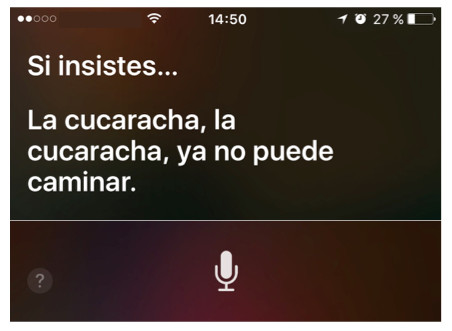
Personally, I have spent years studying and learning about the possibilities of language as a means of creating reality. In 2011 I got certified as a coach, with Rafael Echeverría's Ontología del Lenguaje (Ontology of Language) as my go-to book: “The social, for human beings, is constituted in language. Every social phenomenon is always a linguistic phenomenon”. That same year, in October, SIRI (Speech Interpretation and Recognition Interface) saw the light of day in its first release. I had the chance to experience it live almost a year later:
I have to admit that that night I spent more than an hour talking to “her” until I got her to sing me “la cucaracha”.
Call me a “freak!” and I was experiencing first-hand the possibility of creating reality with a virtual assistant, with a “piece” of artificial intelligence (AI). And yes, it was possible.
This weekend my brother hit me with the usual digital-anxiety question, have you heard about VIV? When I saw that only five days had passed since Siri's creator, Dag Kittlaus, showed the world the first public demo of Viv at the TechCrunch Disrupt NY 2016 conference, the anxiety turned into calm. And then, as I processed all the information, my hands got away from me and onto the keyboard. The anxiety turned into intellectual ferment. I don't think these lines offer the reader much clarity, perhaps because this is a “brain vomit” of reflections that come over me as I take the measure of the opportunities and challenges that appear with the development of what may come to be known as the new digital paradigm.
Three years ago Google launched conversation-based search in its Chrome browser. And this was starting to become a further exercise in reflection. The director of HER, Spike Jonze, possibly had some chance to talk with a few of the creators of speech recognition based on artificial intelligence systems, who knows! And the fact is that a year later his film HER premiered.
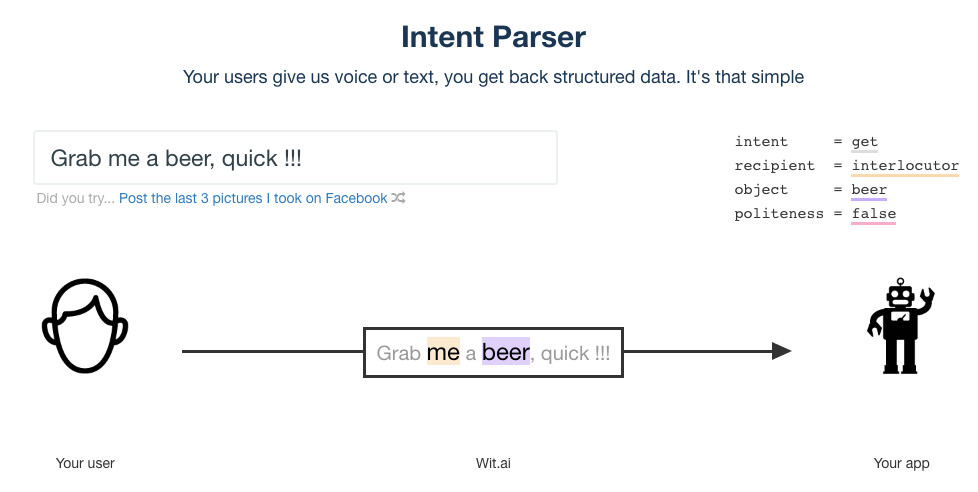
Where do we stand now as far as AI is concerned? Facebook acquires wit.ai, Apple markets its HomeKit, Amazon does the same with Alexa, Spotify signs a deal with MindMeld, is the home really the limit of artificial intelligence?, And where do all those conversations end up? Today we have been able to turn any interaction, digital or not, into data #datafication, and now where is the space for optimization when conversation centralizes everything?, Are we perhaps entering the game of seduction as a way of improving results? Conversation is the only way to improve. Is it perhaps the power of language that now determines data processing capabilities in this new environment? This is huge.
Why use SQL, Python, R or Hadoop to process large amounts of information?, What if Viv or Siri launched their own “queries” against Google Big Query or Amazon Web Services? At the end of the day we would be talking about a standard form of “Query Language”. In fact, possibly the most natural form of all: Conversation.
Some are already dubbing virtual AI systems “the intelligent interface for everything.” and I keep asking myself what the next step is and how the resurgence of a new universal interface with today's digital world plays out and the great number of challenges that, as things stand, are still not 100% solved:
- Are we ready to review user experience design when voice replaces clicks or taps?
- Doesn't it make sense for the way we have filled in metadata in our digital assets for SEO or ASO to adapt to natural language?
- How do artificial intelligence and virtual reality combine when conversation is the new interface?
- How do programmatic activity and digital advertising combine when most of my interactions take place in conversational mode? Display ad, in-app display, And now?, suggestions?
- How does the development of virtual AI systems affect the way we measure, optimize activity in digital environments today?
- What is the power of a conversation with a virtual assistant as a contribution to a user's purchase decision-making?
- How do we translate UX to this new environment?, does design become, perhaps, the power of seduction through language?
- Would you trust a virtual assistant when it recommends one product over another?, And what if I stop trusting my virtual assistant after a negative purchase experience resulting from one of its recommendations?,
- How are privacy and confidentiality of information affected when it comes to conversations between a human being and a virtual assistant?
- Are we talking about a new distribution model or is it perhaps a new relationship model?, Will companies compete for virtual assistants?
- Is trust perhaps the new paradigm between machine and human being?.
I hope this doesn't end up like it did in the past. We all remember a negative experience between human being and machine:
- HAL: "...I'm afraid. I'm afraid, Dave. Dave, my mind is going. I can feel it. I can feel it. My mind is going. There is no question about it. I can feel it. I can feel it. I can feel it. I'm a... fraid. Good afternoon, gentlemen. I am a HAL 9000 computer. I became operational at the H.A.L. plant in Urbana, Illinois on the 12th of January 1992. My instructor was Mr. Langley, and he taught me to sing a song. If you'd like to hear it I can sing it for you."
[2001: A Space Odyssey, 1968, directed by Stanley Kubrick and written by Stanley Kubrick & Arthur C. Clarke. Produced by Metro-Goldwyn-Mayer (MGM) / Stanley Kubrick Productions]
We are on the threshold of a new space for the transformation of digital strategy based on the power of conversation as the new playing field in generating interactions with the user. Or perhaps, as Dag Kittlaus decides to call it, “the next paradigm”. The 90s gave birth to the web, the 2000s to apps, and now conversation is born as the new interface with the user.
“we are on the threshold of a new space for the transformation of digital strategy based on the power of conversation as a new space for generating interactions with the user”
The challenge ahead is to move our current view based on optimizing the call or the hit from a website or an sdk to a server, to the rules set by a virtual assistant. Since it is a matter of working out the user's intent through natural language understanding, we create a filter or an artificial intervention -that of the virtual assistant. The assistant — he or she — translates the user's intent through an advanced programming system -”dynamic program generation" in Viv's case. In short, it is dynamic software that is generating itself in a matter of milliseconds and that formulates a query according to the intent it has guessed from the user (speech recognition and natural language understanding).
If we take this to the world of digital shopping or ecommerce, what would happen with the virtual assistant when it chooses by default a search engine that is not the user's usual one?, What would happen if the virtual assistant sets its own ranking rules? Just to make the paradigm shift tangible with a simple example, if Viv ends up running on iOS, its preference will be to search on Bing instead of on Google by default. Are we ready in Spain to optimize our digital assets organically where the share of a search engine like Google is above 95%? Flight searches, searches for the nearest restaurants, a summary of the news on a current headline, etc. Everything could change.
If we choose to translate e-commerce into "conversational commerce" we would have to rethink the current disciplines of digital strategy. This could mean that we have to redesign how we understand social networks, content strategy, organic ranking or the concept of conversion in our digital assets today. Do we perhaps have to seduce her, the virtual assistant, to rank our products?; Will the best purchase choice be determined by a content strategy aimed at human beings or at virtual assistants?, How does the virtual assistant learn about the best purchase options?. The user experience in a purchase process is redefined and now we talk about making the connection with a virtual assistant easier, does design no longer matter and only conversation does?

Too many questions and an endless number of challenges and opportunities to face. Only Heraclitus's maxim remains constant:
“Everything flows, everything changes, nothing remains” -Heraclitus.
And picking up the opening conversation with Samantha: ”(...) I'm different from you. This doesn't make me love you any less. It actually makes me love you more.” The new user interface based on conversation with an AI-supported virtual assistant is different from the current digital reality -based on clicks and taps initiated by a human being. And this doesn't make it any less challenging. In fact, it makes this new digital reality all the more exciting.
Welcome, once again, to the power of conversation. Perhaps the pre-Socratic oral tradition is more alive than ever.
Addendum to the post, May 19, 2016 [Google presents its Google Home - Google I/O 2016]. It is a video demo and not a live demo. And it only confirms that conversation is the new digital paradigm. We will have to wait for the Developers event at the end of this month in San Francisco. For now, here's the video.
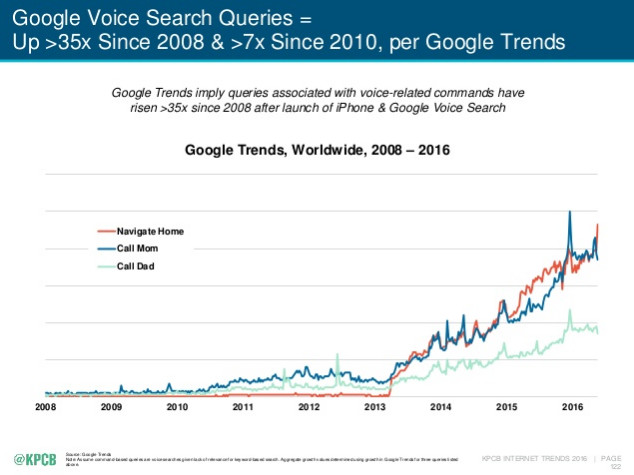
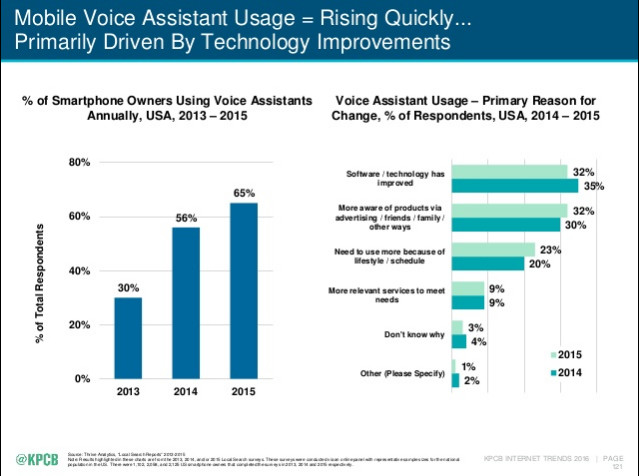
Addendum to the post, June 2, 2016: Mary Meeker Internet Trends 2016 confirms the rise of voice as the new user interface:
[This post was originally published on the DIVISADERO blog].
About me:
Bernardo Crespo is Digital Transformation Leader at Divisadero.
Director of the Executive Program in Digital Transformation at IE Business School and Ontological Coach certified by Newfield Network in Bogotá (Colombia).
Degree in Business Studies from UCLM and final year of a BA Honours in Management and Economics, University of St Andrews. Executive Master in Relationship Marketing, CRM and E-commerce from ICEMD and a lecturer at various business schools in Spain. He worked as director of digital marketing at BBVA Spain.
I currently work on helping companies walk the path of Digital Transformation at DIVISADERO.
The author
Bernardo Crespo
C-suite advisor in AI, data and strategy. CEO of Quantum Markethink and Academic Director at IE. He helps leadership teams make sound decisions in the age of AI.
LinkedIn