I Have CDO -stasis, Can I Be Cured?
The phone starts ringing and unexpected emails burst into the personal inbox: "I'd love to tell you about a position I'm handling…
We are living in a bubble of digital profile hunting. As happens every September / October, and to a lesser extent at the start of each year, head hunting firms and the recruitment departments of large companies are out hunting for the CDO.
The phone starts ringing and unexpected emails burst into the personal inbox: "I'd love to tell you about a position I'm handling and which I think...", “We have an opening for a Director of Digital Transformation…”; “Our client is looking for a Chief Digital Officer profile…” I think this is a unique moment of collective giddiness for all those professionals who have devoted themselves body and soul to making digital strategy and tactics their life. And what if bringing in digital profiles didn't turn out to be the solution to the problem?
Digital transformation is already on the CEO's agenda and the CEO has now solved the problem by looking for a "digital white blackbird". What are the problems that come next?:
- Is the company prepared to place all of its responsibility on a profile who is trying to evolve a corporate culture that has yet to be decided?
- Does the CEO really expect one person, however deeply digital runs through their veins, to fix the company's strategy and culture?
- Is the CEO merely looking for a profile to manage the transformation of the technology stack, the business strategy, the innovation agenda and, at the same time, the short-term P&L?
- Is it possible for a single profile to bring order to the historical chaos of governance by silos and internal competition between the traditional marketing, technology and business development departments?
- Is it possible for this profile to optimise the current business model from digital strategy and create a transitional business model? And is it possible for this profile to define the future drivers of profitability from digital strategy?
Every offer I have received over the past 18 months lacks a clear answer to the questions I have just posed. And it may just be my experience, nothing more than my experience. And I think it is possible that this practice is being repeated more than once.
The problem begins when the CEO has entrusted a partner at a head hunting firm with finding a profile the CEO cannot define. The consultant ties himself in knots trying to put together a job description that was never precisely defined when the decision was taken to bring in a profile to lead the digital strategy. And whose first assignment was exactly that: to build the digital strategy. With the aggravating factor that once they find the profile —and there are many hours behind that search on LinkedIn— there is a risk that the candidate destined to sip the most precious digital nectar may know more acronyms than the head hunting consultant interviewing them. And after seducing partners and recruitment directors, convincing the HRO, and charming the CEO. Then comes the day after. And that day begins with the loneliness of defining an agenda, meeting an endless list of expectations and fitting into a culture that is in the middle of being redefined.
This whole process is what I have wanted to define as “CDOstasis”, or the corporate infection that comes with the arrival of the CDO (Chief Digital Officer) or the DTO (Digital Transformation Officer) or the CMTO (Chief Marketing Technology Officer) or the "digital boss", to make it simpler.
Joking aside, in my view the challenge involves thinking through many of the questions above before setting out to look for the "digital white blackbird".
In the next section I want to run briefly through the challenges to be solved, before looking for the solution to a problem that may well require some prior thought. In the end, that learning is going to come true:
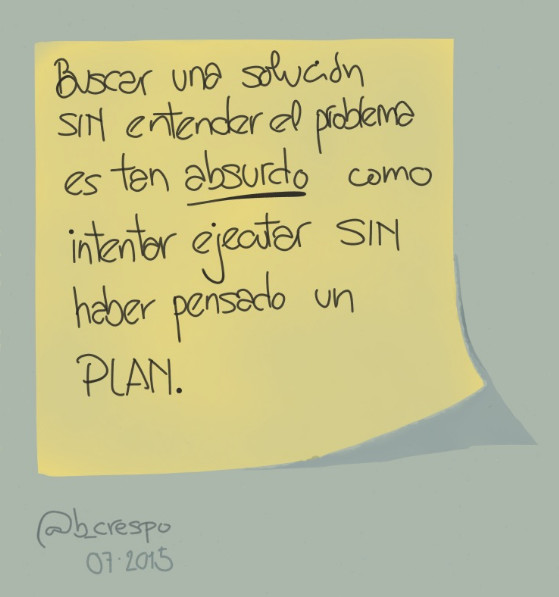
“Looking for a solution WITHOUT understanding the problem is as absurd as trying to execute WITHOUT having thought of a PLAN.” Learning No. 36 - @b_crespo
BREAKING DOWN THE PROBLEM
In a post we shared on the DIVISADERO blog —Digital Transformation: deconstructing the challenge from the CEO down, Esperanza Pariente reflected on the vectors of digital transformation (Organisational Model, New Ways of Working, Innovation Strategy, Cultural Transformation, and, Data & Technology) and the different areas of the organisation with an impact on the transformation process.
I want to bring back now some of those valuable reflections:
- Limiting aspects of the current organisational model in a possible scenario of competing with incumbent models, e.g. FinTech, HealthTech, TravelTech, MotorTech, InsurTech, etc...
- Fit of the current organisational model to the response times involved in generating a new value proposition.
- Detection of pockets of initiative and digital talent already existing in the organisation.
- Drawing up a dictionary of emotional skills and technical competencies to bring in and encourage.
- Analysis of the digital maturity of my vertical and my competitors
- Tech & Data Audit of our organisation
It is usually easier to entrust all these challenges to the new profile and, in my view, given the high strategic impact of these reflections, the conversation should be led by the CEO in the first person. There may be an opportunity to recover internal cohesion before adding a further source of momentum to the corporation.
PRIORITISING THE AGENDA
Once the challenge has been broken down by areas of the organisation, this may be the moment when you can start to generate an agenda in which user experience, technology, the distribution model, marketing, talent management, compliance constraints and the definition of the new culture can be approached from an evolutionary rather than a transformational perspective. It may be possible to state that digital transformation is dead if we have managed to facilitate change with the right focus on specific challenges. Here is a reminder from that post about a possible "Decalogue for facilitating digital change":
- Leading digital change is a matter of people. And of skills.
- Strategy sits above technology, and technology is necessary, and, it is not sufficient.
- You cannot start digitalising a business without the right push (it is a top-down exercise).
- Managing digital talent is the most valuable lever in the process of adapting your business to digital.
- The company's natural adaptation to social media, analytics, mobile and cloud tools is an important catalyst.
- Knowing and handling data in real time is one of the decisive factors in helping you digitalise your business.
- An attitude of accepting risk, or a test & learn culture, greatly facilitates digital adoption.
- The ability to collaborate internally and externally, even with competitors, is another important catalyst for change.
- Curiosity, passion, the absence of resistance to change and the exchange of knowledge drive digital strategy.
- Adopting digital as a lever for transformation is a path and not a goal.
In my view it is possible to define an agenda in which the organisation's different challenges surface, once the desirable future situation has been clarified. Without getting close to that desirable situation, it is hard for a single profile to push the transformation of an entire organisation. We may find a smart guy or a smart girl and they will never have superpowers (one day, in a small circle, I will tell you the story about my hairdresser).
STARTING THE SEARCH (WHITE UNICORNS)
And now it is time to work on each of those agenda points with a specific analysis of the profiles needed before entrusting the whole burden of responsibility to a superhero or a superheroine who will hardly be able to drive the digital bus, change the wheel with the bus in motion and guarantee a pleasant journey for everyone on board. I have always had doubts about the need to bring in more talent without having explored the possibilities of my own organisation. As David Rock put it, managing the balance between the sense of status, certainty about professional security, decision-making autonomy, relational skills and the sense of fairness between the company's current management and this new Digital profile is a highly complex challenge.
If it is already difficult to work out how to govern a strategic lever in an environment of complete uncertainty, adding the difficulty of fitting that new profile in with a wary management team is piling on even more complexity. I do not think there is any need to make it harder for them.
I myself was reflecting back in 2014 on the profile of digital change managers, these white unicorns we are all now striving to find. And digital profiles are not made up of digital competencies alone. The environment we are living in —uncertainty, the rules of the game being altered, a new asymmetry in the relationship between companies and users— probably calls for emotional competencies.
I think that the universe of possible knock-on effects, of new and complex challenges an organisation can face when it entrusts the challenge of digital transformation to a single person, is not worth the leadership wear and tear it can bring with it. And yes, there is one person who has to put that responsibility in their backpack: CEO
"Lead, follow or get out of the way” - Thomas Paine.
And I will not add a single comma. The best advice I have ever been given.
The responsibility to lead cannot be delegated. Digital is not a passing challenge, it is the new environment.
This post was originally published on: the DIVISADERO Blog.
The author
Bernardo Crespo
C-suite advisor in AI, data and strategy. CEO of Quantum Markethink and Academic Director at IE. He helps leadership teams make sound decisions in the age of AI.
LinkedIn