Digital Transformation Is Not a Goal to Reach
[This post was originally published in EXPANSIÓN: Economía Digital on November 26, 2015]
[This post was originally published in EXPANSIÓN: Economía Digital on November 26, 2015]

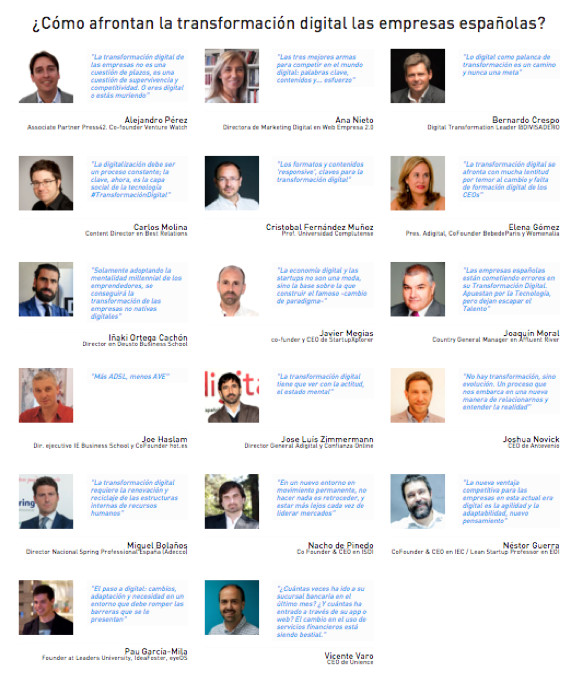
HOW DO SPANISH COMPANIES DEAL WITH DIGITAL TRANSFORMATION?
The real trigger of digital transformation is always the customer. And it starts when their buying decisions wreck classic distribution models.
Digital transformation by emergency comes when "smartphone" penetration figures clearly affect the buying decisions of end users in any industry. In my view, there are three basic triggers that set off a digital transformation process in a large company: the sudden emergence of new pure-play digital models in the industry, the need to copy the steps of the first competitor to make a move, or the strategic instinct for sensing paths already under way in other verticals.
Possibly, the final trigger is when a competitor's announcement that it is setting out on the digital transformation path comes together with the fact that most of the decision-makers on the leadership team had already anticipated part of these changes in the past. The problem comes when someone repeats that fatalistic line, "I told you so". Well, n****ow it is time to execute and not to bemoan it.
Nobody transforms their business overnight. It is a process that comes loaded with cultural change and affects the traditional way of making decisions. That is why much of the conversation around the concept of digital transformation is led by strategy, human resources and leadership consultancies, not only by digital ones. Large organizations usually were - and many still are - used to top-down decision processes, where the end customer ultimately suffered the excessive confidence of the CEO and of some external visionary. As a result of this decision-making, changes were set in motion in the organization and in its processes, changes that the rest of the middle managers had to guess at and that, ultimately, even the end customer came to notice.
"Digital as a lever for transformation is a path and never a goal" -- @b_crespo
The result today is diametrically opposed. The organization has to learn to adapt to the changes in the user's decision-making. And perhaps an advanced way of knowing how to adapt is to take on an organizational culture leveraged on knowledge of the user through data (and I refuse to call it "la data", as we insist on saying in Spanish). Data is the new paradigm and it is the trend to follow -"Data is the New Black". Those organizations that can read user intent in real time, or that are able to learn with the user, are the ones best prepared to adapt to a new environment in which digital dominates the ways of doing and deciding. Inside the company, those "hard" areas, or those more used to answering the questions the CEO asks (Sales, Finance), are somewhat removed from the reality of end users and have therefore not been able to read as clearly that digitalization was not only a potential source of cost savings, but a new way of relating to the customer. That knowledge and daily pulse of the end customer was led by areas considered "soft", such as Marketing, Communications, Channels or Customer Service.

WHO LEADS DIGITAL TRANSFORMATION?
The path of digital transformation varies depending on who leads it. If the leadership comes from business areas, the natural orientation will be towards innovation in new forms of acquisition. When the leadership comes from Channels or Customer Service, the improvements will probably go along the lines of offering the customer a more consistent experience regardless of the channel they choose when dealing with the company. When Operations or Systems is the best-placed player within the corporation, digital transformation will aim to bring order to the lack of connection between the business process systems and the growing flow of information and interactions that results from the new digital assets. Whoever leads this change, the best option is collaboration between all the different views.
Whoever the new leader is, the CEO should always be involved in person. When new roles appear, such as the Chief Digital Officer or a Digital Transformation Officer, in my view the reading to make is that a manager of the transition process has just been appointed. And it may well be a sound idea when the change to be taken on carries a certain weight, either because the industry itself is in the middle of a transformation or because the old ways of deciding in the company call for the mediation of a "primus inter pares".
Whatever path is chosen, and as I said in an earlier post, "adopting digital as a lever for transformation is a path and never a goal". If digital transformation becomes an obsession, we run the risk of confusing all the current players inside the organization and creating a certain climate of winners and losers. In my view, digital transformation inside a company is and must be a collaborative exercise.
WHO SHOULD YOU TURN TO FOR HELP ALONG THAT DIGITAL TRANSFORMATION PATH?
This is a reflection in which my answer may well carry a good deal of bias, and I prefer to think the answer over. And I have one.
I'll leave it for another post.

_____________________________________________
Other related POSTS:
- How to Measure the Success of your Digital Strategy
- Closing the Circle of Digital Strategy
- Digital Transformation Is Dead
- Why Digital Can Damage your Strategy
- 4 Stages of Competence in Digital
- Some Lies About Digital Transformation
- 5 Inspiring Tips to Help you with Digital Transformation
_____________________________________________
Bernardo Crespo is Digital Transformation Leader at DIVISADERO and an Ontological Coach certified by Newfield Network in Bogotá (Colombia). He holds a degree in Business Studies from UCLM and completed the final year of a BA Honours in Management and Economics, University of St Andrews. Executive Master in Relationship Marketing, CRM and E-commerce from ICEMD, and a lecturer at several business schools in Spain. He worked as head of digital marketing at BBVA España.
These days I help companies walk the path of Digital Transformation at DIVISADERO.
I have discovered and keep discovering the beauty of play applied outside of play #gamification
The author
Bernardo Crespo
C-suite advisor in AI, data and strategy. CEO of Quantum Markethink and Academic Director at IE. He helps leadership teams make sound decisions in the age of AI.
LinkedIn