Critical Thinking Squared
If critical thinking becomes the main skill to develop in an era of coexistence between humans and machines (the era of Augmented Intelligence)…
1. Toward a Formula That Condenses Critical Thinking
If critical thinking becomes the main skill to develop in an era of coexistence between humans and machines (the era of Augmented Intelligence), how can we strengthen it?
Let's start by breaking the problem down. Can we not begin with a practical exercise to analyze the variables that make up critical thinking? Let's take a piece of fake news, for example.
Spotting a piece of fake news requires deep, detailed reading. Generally, curiosity is the first step: that intuition telling us something "doesn't add up" in the headline or in the body of the story. Curiosity always arises because we have previously developed a logical architecture of arguments (logical composition) that lets us sense and tell the coherent from the incoherent.
This capacity for abstraction is no small thing and is built over a whole lifetime. This capacity for abstraction is what we call tacit knowledge, or intuition accumulated over a whole lifetime. In addition, when we take on the hypothesis that a piece of information is false, we apply exhaustive, structured criteria to ground our analysis (algorithmic thinking).
For example:
Is the outlet that published the story a recognized one?
What is its editorial line? Is it a reliable outlet?
Does the story fit the outlet's editorial line?
Do I know the journalist, and what is their track record?
Are sources cross-checked, or are opposing views presented?
From that point on, once we have a clear structure of analysis in place, we return to deep reading, planning in advance what we set out to find and where we can validate it (fact checkers, solid outlets with proven reliability), analyzing the causes that let us conclude whether we are facing a false or a true story.
All this work can be laid out pedagogically in a simple formula that helps us remember what feeds critical thinking:
𝙲𝚃 = 𝙲 𝚡 [(𝙻𝙲 + 𝙰𝚃) 𝚡 𝙰]^ (𝙳𝚁+𝙿+𝙲𝙰)
Where:
CT (Critical Thinking): The final value of our capacity for judgment.
C (Curiosity): The Activation Coefficient. It is an external multiplier. If curiosity is zero (C=0), it doesn't matter how good we are at everything else, critical thinking is not activated.
LC + AT (Logical Composition + Algorithmic Thinking): The Structural Base. It is the sum of our capacity to reason and to process sequences.
A (Abstraction): The Scale Factor. It multiplies the structural base because it keeps our logic from staying trapped in a single example and makes it applicable to any context.
^(DR + P + CA) (Deep Reading + Planning + Cause Analysis): The Exponent, the Power. It represents training. The more we practice these activities, the more we exponentially raise our base capacity.
However, this analysis as a deconstruction of critical thinking, though at first sight it may look like a complete exercise, has gaps I would like to share in detail. And that requires jumping to the next block, in order to move beyond the mechanistic reduction of a formula.
2. Criticisms of the Mechanistic Reduction Model
The previous exercise has enormous pedagogical power. Simplifying critical thinking into a formula makes it quick to see that this capacity does not arise by chance, but depends on the interaction between curiosity, structured reasoning, abstraction and intellectual training.
That said, any model is by definition a simplification of reality, and as a simplification it isolates potential vectors it leaves out of account. If we want to evolve human beings rather than reduce them in an era of systematic cognitive erosion (a result of the continuous use of AI), we have to work hard to neutralize that mechanistic reduction.
When we look more deeply at this earlier formulation, several limitations appear. The risk is not in the formula itself —which is useful as a teaching tool— but in believing that critical thinking can really be reduced to a mechanical structure.
The first problem arises because the formula mixes different levels of intellectual life. A single equation brings together dispositions of character (curiosity), cognitive faculties (abstraction), operational skills (logical composition), research methods (causal analysis) and cultivation practices (deep reading). Each of these elements belongs to a different plane of intellectual formation. A psychological inclination is not the same as an acquired skill, nor a mental capacity the same as an educational practice.
This mix creates an illusion of homogeneity: it looks as if all the elements operate the same way inside the equation. But in reality they perform radically different functions.
Another limit of the formula model is that it gives excessive weight to the analytical dimension of critical thinking. The formula puts the focus on logic, abstraction, sequencing and causal analysis. These capacities are important, no doubt. Without them, thinking becomes confused or inconsistent.
But thinking critically is not only about reasoning well.
One can think masterfully and be a master of manipulation. Critical thinking also involves questioning assumptions, identifying invisible frames, recognizing one's own biases, interpreting meanings, weighing degrees of uncertainty and considering the human consequences of our conclusions. Critical thinking is not only analytical; it is also epistemological, hermeneutic, reflective and ethical. In other words, critical thinking does not just analyze data, it must question the origin of knowledge, interpret deeper meanings and demand ethical reflection in order to act justly and consistently. The sequence of the fake news exercise was an exercise in inductive manipulation, generating a rule from one concrete example. And that leads into the next weakness of the formula.
A third debatable point is the central place given to algorithmic thinking. This kind of thinking is extraordinarily useful in structured contexts: programming, engineering, logistics or the resolution of complex processes. However, not every form of critical thinking is algorithmic.
Interpreting an ambiguous text, weighing a moral dilemma or understanding a social phenomenon calls for more deliberative, contextual forms of reasoning. In these cases, critical thinking looks less like running through a sequence of steps and more like a process of prudential interpretation, where checking against other people is perhaps worth more than the individual sequence of analysis.
So, although algorithmic thinking can be a valuable tool, it cannot be considered the universal pillar of critical thinking.
Can we not also question curiosity? The formula presents curiosity as the fundamental engine that activates the whole system. The intuition is right: without curiosity there is no intellectual search. However, curiosity on its own does not guarantee critical thinking.
A mind can be extremely curious and still move superficially between stimuli without building solid knowledge. Curiosity needs to be accompanied by other dispositions: intellectual discipline, cognitive patience, honesty with the evidence and the capacity to admit mistakes.
Curiosity opens the door to knowledge, but it neither orders nor distills it.
Another problematic aspect is the emphasis on abstraction as a scale factor. Abstraction lets us identify general patterns and build conceptual models. Without it, thinking stays trapped in isolated examples. But too much abstraction can also produce errors. When contact with concrete reality is lost, we get elegantly built theories that are incapable of explaining real situations.
Mature critical thinking needs to move continuously between two poles: the model and experience, the general and the particular, the concept and the context. This movement is essential to avoid two equally problematic extremes: excessively abstract thinking and purely anecdotal thinking.
Another limitation of the model shows up in the so-called “roots” of critical thinking. Our initial formula proposed three main practices: deep reading, scenario planning and the investigation of causes. These activities are valuable, but they do not exhaust the set of practices needed to cultivate critical judgment.
Equally fundamental practices are missing, ones that go beyond the individual sphere: argumentative dialogue, the systematic cross-checking of sources, reflective writing, the detection of fallacies or the review of one's own error.
Critical thinking does not develop only by reading or by analyzing problems on an individual plane. It also grows stronger when it is confronted with other perspectives and submitted to the scrutiny of other minds.
Community helps strengthen critical thinking.
Finally, the deepest problem with the formula is that it turns a complex phenomenon into an almost engineering-style model. The equation suggests that critical thinking can be calculated as a stable combination of factors. But reality is more stubborn.
Critical thinking is historical, contextual, situational and deeply human. It develops over time, in interaction with experiences, learning communities and real dilemmas.
Reducing it to a formula helps to teach it, but it is not enough to understand it.
In other words: the formula is useful as a pedagogical entry point, but insufficient as a complete explanation.
3. Toward a Collaborative Ecology of Critical Thinking
If we abandon the mechanistic view of critical thinking, a more interesting question arises: how should we understand it then?
A richer alternative is to replace the idea of a formula with the idea of a multidimensional architecture. Instead of imagining critical thinking as a calculable product, we can understand it as a complex configuration of dispositions, skills, regulations and practices.
This perspective recognizes that critical thinking is not a single skill, but a formative ecology.
Different levels come into play in this ecology, each performing a different function.
LEVEL 1. First come the ethical-epistemic dispositions, which shape the individual's intellectual character. Here we find qualities such as intellectual humility, tolerance of uncertainty, honesty with the evidence and the courage to revise what one believes one knows. These dispositions turn spontaneous curiosity into a responsible search for truth.
Without them, thinking can become dogmatic or narcissistic.
LEVEL 2. Second comes metacognition, that is, the capacity to examine one's own thinking. Thinking critically is not only about analyzing external objects; it also involves examining how we are interpreting those objects. And this practice requires the humility of impartial observation of our own reality. And it stings to do it alone.
This demands that we constantly ask ourselves:
What assumptions am I taking as valid?
What biases may be influencing my judgment?
Am I defending an idea because it is right or because I want it to be right?
This self-regulation is essential to keep analytical capacity from becoming an instrument in the service of pre-existing prejudices.
LEVEL 3. A third level is made up of the dynamic faculties, which allow us to swing between abstraction and concreteness. Critical thinking is not linear; it works more like a pendulum. Sometimes we need to abstract in order to grasp general patterns. Other times we need to return to the concrete case to avoid excessive simplifications. The initial formula was one of them.
This balance between model and reality is what keeps theories from turning into elegant but incomplete explanations.
LEVEL 4. The fourth level corresponds to the operational skills: logic, text interpretation, detection of fallacies, evaluation of evidence or, in certain contexts, algorithmic thinking. These tools make it possible to structure reasoning and to analyze the validity of arguments and information.
But tools on their own do not guarantee good judgment.
LEVEL 5. Here a frequently forgotten dimension appears: the ethical dimension of critical thinking. A line of reasoning can be perfectly coherent from a logical point of view and still produce deeply unjust decisions. History is full of perfectly stupid and unjust syllogisms.
That is why critical thinking must orient itself toward a normative horizon that includes a sense of justice, regard for the other as a legitimate other and the assessment of the human consequences of our decisions.
Without this ethical dimension, critical thinking can degrade into mere instrumental sophistication: an intelligence able to justify almost anything.
LEVEL 6. Finally comes a decisive element: the social practices of cultivation. Critical thinking does not develop only inside the individual mind. It grows stronger when thinking is exposed to the friction of reality, of evidence and of other minds.
Rigorous dialogue, the cross-checking of sources, argumentative writing and peer review are mechanisms that force us to put our ideas to the test.
This friction is essential. Without it, thinking becomes self-referential and loses its capacity for correction.
That is why critical thinking cannot be understood as an individualistic practice. It is, to a large extent, a communal practice.
Scientific communities, universities, academic seminars and public debates exist precisely to create spaces where ideas can be confronted, corrected and evolve.
In short, the ecosystem of critical thinking looks more like a practice of collective ecology than a formula for individual, mechanistic analysis. In this sense, critical thinking is more in tune with an ecosystem than with an isolated skill.
The following table is a valuable exercise by way of summary
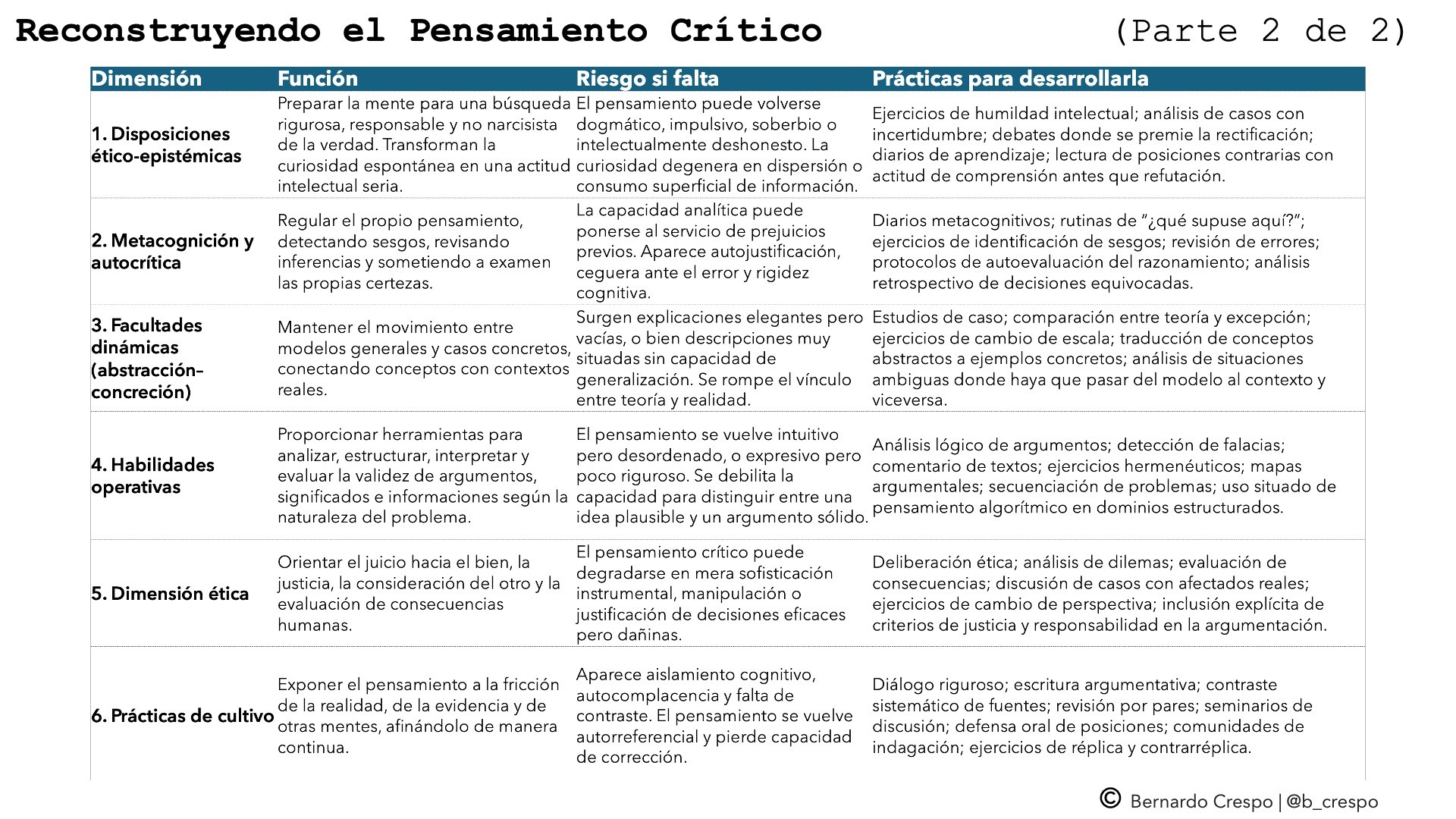
In an ecosystem, different elements interact and regulate one another. In the same way, critical thinking emerges when dispositions of character, self-regulation mechanisms, intellectual tools, ethical orientation and social practices combine dynamically.
When any of these elements disappears, the ecosystem loses its balance.
Without ethical dispositions, thinking becomes manipulative. Without metacognition, it becomes dogmatic. Without analytical tools, it becomes confused. Without social cross-checking, it becomes self-referential.
That is why developing critical thinking in the era of Augmented Intelligence is not simply about teaching reasoning techniques and squeezing models until we get the result we want. It is about cultivating a complete intellectual ecology. And in community, it works better.
It all starts, without a doubt, with individual curiosity. That intuition that leads us to ask whether something doesn't fit. But curiosity only flowers fully when it meets practices that guide it and communities that put it to the test.
A responsibility that requires exposing oneself continuously to reality, accepting the friction of evidence and listening to other minds with a genuine willingness to learn.
Only in this way can judgment be refined continuously.
And only in this way can critical thinking fulfill its most important function: helping to build decisions that are fairer, more human and more aware of their consequences in the shared world. It is very hard to develop critical thinking without a balanced view of the common good, and without a non-negotiable perspective on human dignity.
Critical thinking, in the end, is not just a cognitive skill. It is a form of intellectual responsibility exercised collectively, in community.
Note: [This article is tagged as "Human led". Content led by a human. Machines conduct checks, highlight and correct errors, enhance output. Scheme based on the Dubai Future Foundation. "Human-Machine Collaboration (HMC) Icons." Dubai Future Foundation, dubaifuture.ae/hmc]

www.bernardocrespo.com/#aboutme
Bernardo Crespo is a seasoned digital transformation and data strategy leader with over 25 years of experience. He has held leadership positions in Fortune 500 companies and digital consultancies, and has founded and advised numerous startups and venture builders. Currently, as CEO of his own firm, Quantum Markethink, he provides strategic guidance to C-suite executives, helping them navigate the complexities of digital transformation.
Furthermore, he serves as an Academic Director at IE Executive Education, where he brings his expertise in emerging technologies, digital strategy, data strategy, and artificial intelligence to the classroom. Prior to these roles, he spearheaded digital transformation initiatives at Merkle Spain and led digital marketing at BBVA, where he notably pioneered the application of gamification in banking.
Bernardo is also the co-author, with Gam Dias, of "The Data Mindset Playbook: A Book about Data for People Who Don't Feel Like Reading about Data" (KDP, March 2023).
Articles augmented by AI: Newsletter "My AI-ter Digial Ego"
Human craft: Newsletter "Digital Sustainability"
NEW BOOK: I have taken the liberty of compiling my reflections on AI into a book that, I promise, will see the light of day before the summer ends. | TEXT ME WHEN THE BOOK IS READY
The author
Bernardo Crespo
C-suite advisor in AI, data and strategy. CEO of Quantum Markethink and Academic Director at IE. He helps leadership teams make sound decisions in the age of AI.
LinkedIn