Can we define a digital roadmap for Spain?
Last November Spain set up, for the first time, a Secretariat of State for the Digital Agenda. At business level, 74% of corporations in Spain are tackling a digital transformation project.
Last November Spain set up, for the first time, a Secretariat of State for the Digital Agenda. At business level, 74% of corporations in Spain are tackling a digital transformation project. There is ample evidence of how sensitive and how critical digital transformation is, in the private sphere as much as in the public one. Is it possible to draw recommendations from this study in order to define lines of work, in both the public and the private arena, towards building a collaborative, favourable and prolific context? Can we help co-define that digital roadmap? That is my intention.
[Excerpt: 2017 DIVISADERO IE Business School Barometer]
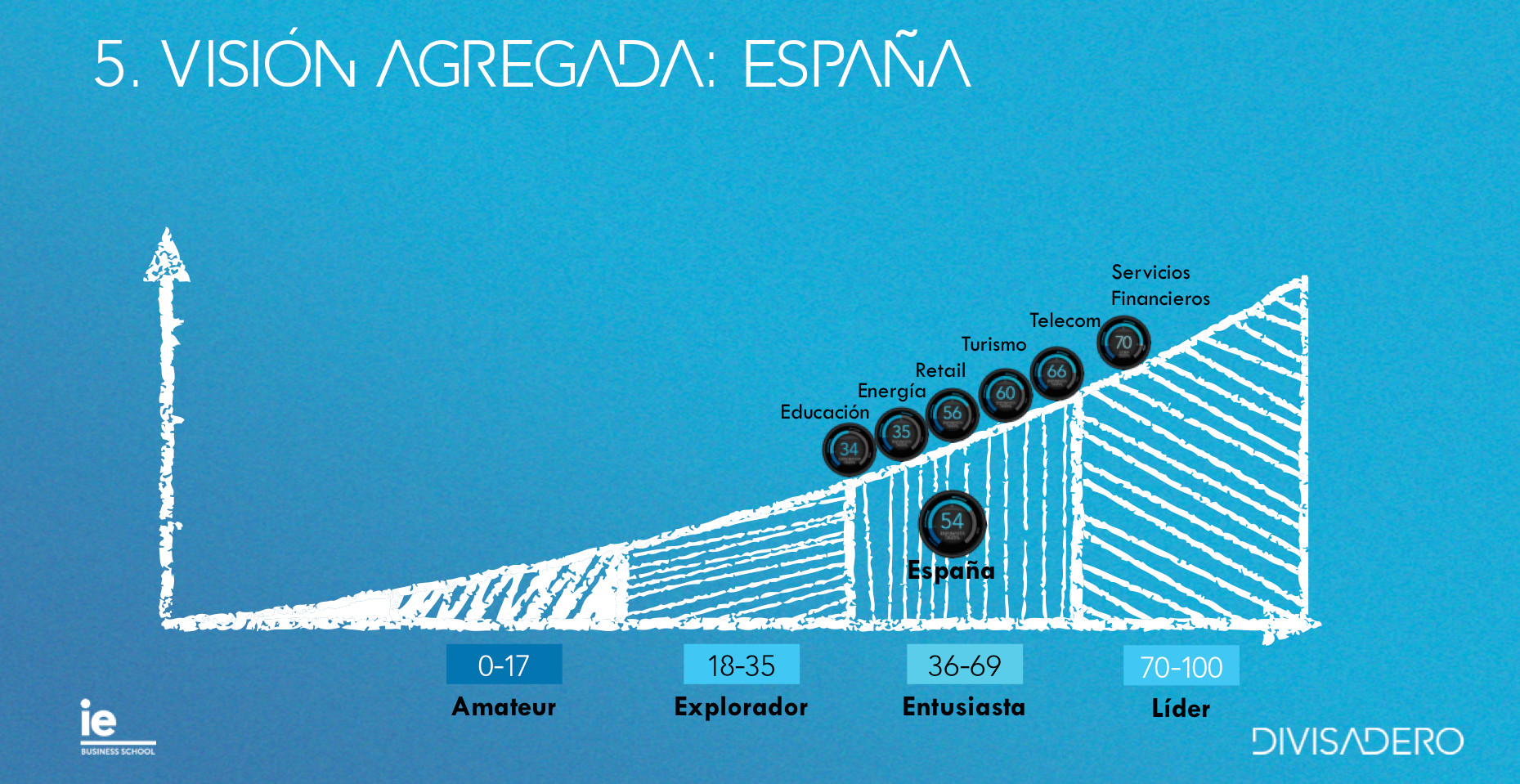
Overall, the score obtained by Spanish private organisations, under DIVISADERO's digital transformation curve, is 54 points, thus grouping private-sector companies as digital enthusiasts. There is still room for improvement. Other country-level reports we have had access to, normalising the data to a base of 100, place Spain in a position that ranges between 50 and 55. Specifically, the DESI (see http://ec.europa.eu/digital-agenda/en/digital-agenda-scoreboard), the 2016 Digital Economy and Society Index, places Spain at the European Union average with a total summary score of 0.52 out of 1. Whatever the composition of the different indices, a number of indisputable areas for improvement can be seen for a country where Internet penetration is ubiquitous (more than 90% of users have a smartphone).
Our approach to improvement, in the case of the 2017 barometer, once these data are in, is to set out a series of reflections that make it possible to establish a roadmap. We have carried out an assessment of the digital transformation of the different industries — a vertical view. In addition, we have assessed the performance and digital maturity that each functional area exercises within its verticals — a cross-cutting or functional view.
Finally, our focus is to be able to draw learnings at a global level — a business view — that can help define private and public agendas with the aim of moving digital transformation forward.
A few months ago, before the creation of a public figure responsible for the digital transformation of our economy, at DIVISADERO we were making the following reflections out loud. Some of them are already answered today, or in progress. We want to help clarify the remaining questions:
- What should be the role of the public body/entity (Secretariat of State, Expert Programme, etc.) that regulates, promotes and encourages Digital Transformation in Spain? [Answered]
- What is the objective of promoting Digital Transformation from a public entity? What effects will it bring to the Economy? [Work In Progress]
- How will the promotion of Digital Transformation from the Public sphere affect the Spanish Economy? Why or why not? [Work In Progress]
- Are politicians (our public representatives) aware of the need to invest in Digital Transformation? Do they realise how important digital strategy is for the Spanish Economy? [Answered]
- Will we have a line item in the State's general budget that puts Digital Transformation at the top of the priority list in the search for growth? [Answered]
- Are our representatives equipped to tackle and understand what Digital Transformation is (public and private spheres), and to take on this challenge as their own? [Work In Progress]
- Regulation and Taxation: rules for tackling Digital Transformation in Spain [Work In Progress]
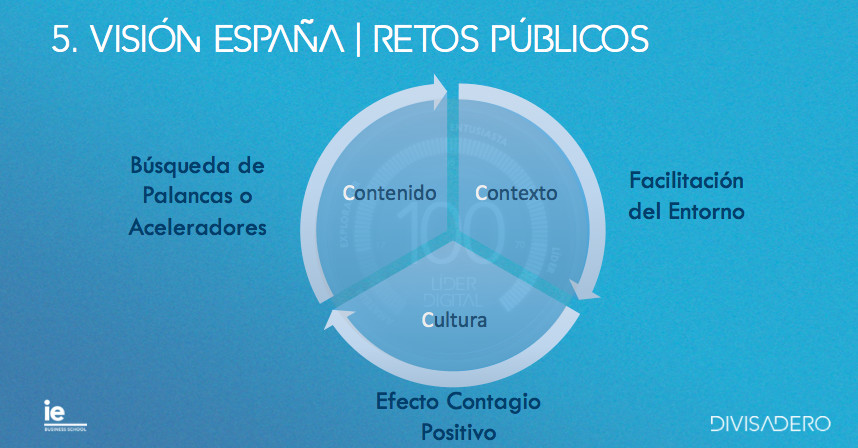
In this edition of the DIVISADERO Barometer we want to offer some of these learnings and make the next steps easier. By way of summary, we highlight the following areas of work around 3 levers (c's): Culture, Context, and Content:
CULTURE | Positive Contagion Effect: Without being able to draw standard conclusions for every vertical, it is possible to state that there are cross-cutting learnings, or cross-pollination of good practice, between verticals. Who should bring together this good-practice role in order to improve and enrich competitiveness? In our view, that space falls directly to the public sphere. Is it possible to create a body of experts or an observatory that shares that role? Along these lines, learnings can be drawn about capabilities to develop in companies, talent to bring in and to promote, as well as case studies or best practices learned. We have already said that digital transformation is not only a strategic challenge; the cultural challenge is perhaps the greatest of the challenges of digitalisation.
CONTEXT | Enabling the environment: In most situations, the verticals that have gone furthest in their digital transformation process have done so pushed by movements coming from the end consumer. It is no coincidence that Banking is closer to the leadership zone than Energy. The user has simply changed the way they make purchase decisions and this directly affects the different players in the industry. Is there any way to ease the competitive playing field while guaranteeing that past rules or regulations cannot cloud it? Can best practices from other countries be identified in order to create an environment that enables digital transformation and therefore the competitiveness of companies at country level?
CONTENT | Looking for levers or accelerators: In the search for levers or accelerators of digital transformation, our clear commitment is to the axis of technology, the use of data and people. While technology adoption is universal in scope and the integration or adoption curves in the use of new technologies tend to shorten over time, at DIVISADERO we are backing personal competences and skills, as well as the use of data, as transformational levers. We consider that the content of any digital transformation strategy should be geared, in our view, to strengthening the detection of internal talent in companies and driving the development of personal skills to manage an environment with high doses of complexity, ambiguity and uncertainty. In addition, the development of digital competences and the strategic use of the possibilities that data opens up in organisations will be the competitive edge over the next 12-18 months. The fact that only one in four senior executives (C-level) interviewed states that digital data is a lever for strategic decision-making confirms this gap.
Transforming digitally is possibly a fantasy or a dream for many. I believe it is possible to bring together public and private initiatives and drive the digital evolution of an economy. With a single day left before he stops being POTUS, the first digital president in the history of the United States is the evidence:
"If you're walking down the right path and you're willing to keep walking, eventually you'll make progress." - Barack Obama
[The 2017 Barometer on the digitalisation of Spanish companies has been produced by DIVISADERO and IE Business School on the basis of an in-depth study in which executives from more than 150 corporations and institutions in Spain took part [DOWNLOAD the full report].
The author
Bernardo Crespo
C-suite advisor in AI, data and strategy. CEO of Quantum Markethink and Academic Director at IE. He helps leadership teams make sound decisions in the age of AI.
LinkedIn