Acceptance vs. Arrogance
Damn reality doesn't match my expectations (arrogance). In other words, our starting hypothesis isn't confirmed. Any researcher would have learned…
Damn reality doesn't match my expectations (arrogance). In other words, our starting hypothesis isn't confirmed. Any researcher would have learned that they've just closed off one door of interpretation, or that the experiment led them to discover a barren path, and now they can choose many other paths. In other words, I haven't erred, I've discovered a way not to solve the problem (acceptance). There's a lot in this reflection about generational anchors in the culture of error and the culture of trial-and-learning.
[This POST was previously published on Bernardo Crespo's blog under the title "Acceptance versus Arrogance: Culture and Gen X, Y, Z]
Unlike the researcher's attitude, most of us fall into frustration and self-reproach. And if we're a bit more arrogant, into blame -and we pin it on the person next to us.
None of the richest countries in the world had planned for a scenario like the current one. Strategy-making in times like these reminds me of the Golpes Bajos song: "🎶 Malos tiempos para la lírica 🎶" ("Bad times for lyric poetry"). It's also true that doing analysis after the fact is a less complex exercise (I refuse to label it easy).
An African proverb says that "until lions have historians, tales will always glorify the hunter". And still I believe we can draw lessons from the interpretation of history. And every new piece of data on infections and deaths is already part of the narrative of a historical account.
"Nothing is as good as it seems, and nothing is as bad as it seems. Somewhere in between lies reality." ― Lou Holtz
In my view, the management of this pandemic offers two clearly differentiated models for tackling the same problem (Arrogance vs. Acceptance). Let me use a personal interpretation of an excellent data-visualization exercise on contagion created by the Financial Times [1] to illustrate my argument.
The chart, the data-visualization exercise, is brilliant, and of course the handwritten annotations are my own work. Nothing could be further from my intention than to pin this interpretation on the Financial Times.
Need I say more? Perhaps not. Before debating "Arrogance" and "Acceptance," let me make a brief detour on the role of culture in leadership styles and the different generations in the workplace.
THE ROLE OF CULTURE IN STRATEGY
A while back I was fascinated by a piece on the role of culture and its anchors to the concept of leadership [2]. In fact I have on my reading list the book "The Culture Map: Breaking Through the Invisible Boundaries of Global Business," written by Erin Meyer in 2014. This author and INSEAD professor has co-written with Netflix CEO—Reed Hastings— a book that will be published in May this year. There will be time to add this new one to the reading list too.
To put it very simply, Erin Meyer reflects in her HBR article [2] on two axes, or two domains, for mapping leadership styles: attitude toward authority and the decision-making process. The extremes of the first dimension -authority- are egalitarian models (e.g. Nordic countries) at one end and hierarchical models (e.g. China) at the other. As for the decision-making dimension, the spectrum ranges from top-down models (e.g. the United States) to consensus models (e.g. Japan).
Erin Meyer maps country cultures across these axes based on more than a decade of research (2003-2016) with interviews with managers from each of these countries. In the image below you can find a sample of some countries plotted on the axes of attitudes toward authority and attitudes toward decision-making. For those of you looking for Spain, I'll give you the "spoiler" after you've read this article.
The learnings are many, and they're detailed in her book. To put it simply and get to the point, there are four leadership-style models depending on a country's culture:
- Consensus + Egalitarian: Denmark, the Netherlands, Norway, Sweden
- Consensus + Hierarchical: Belgium, Germany, Japan
- Top-down + Hierarchical: Brazil, China, France, India, Indonesia, Mexico, Russia, Saudi Arabia.
- Top-down + Egalitarian: Australia, Canada, the United Kingdom, the United States
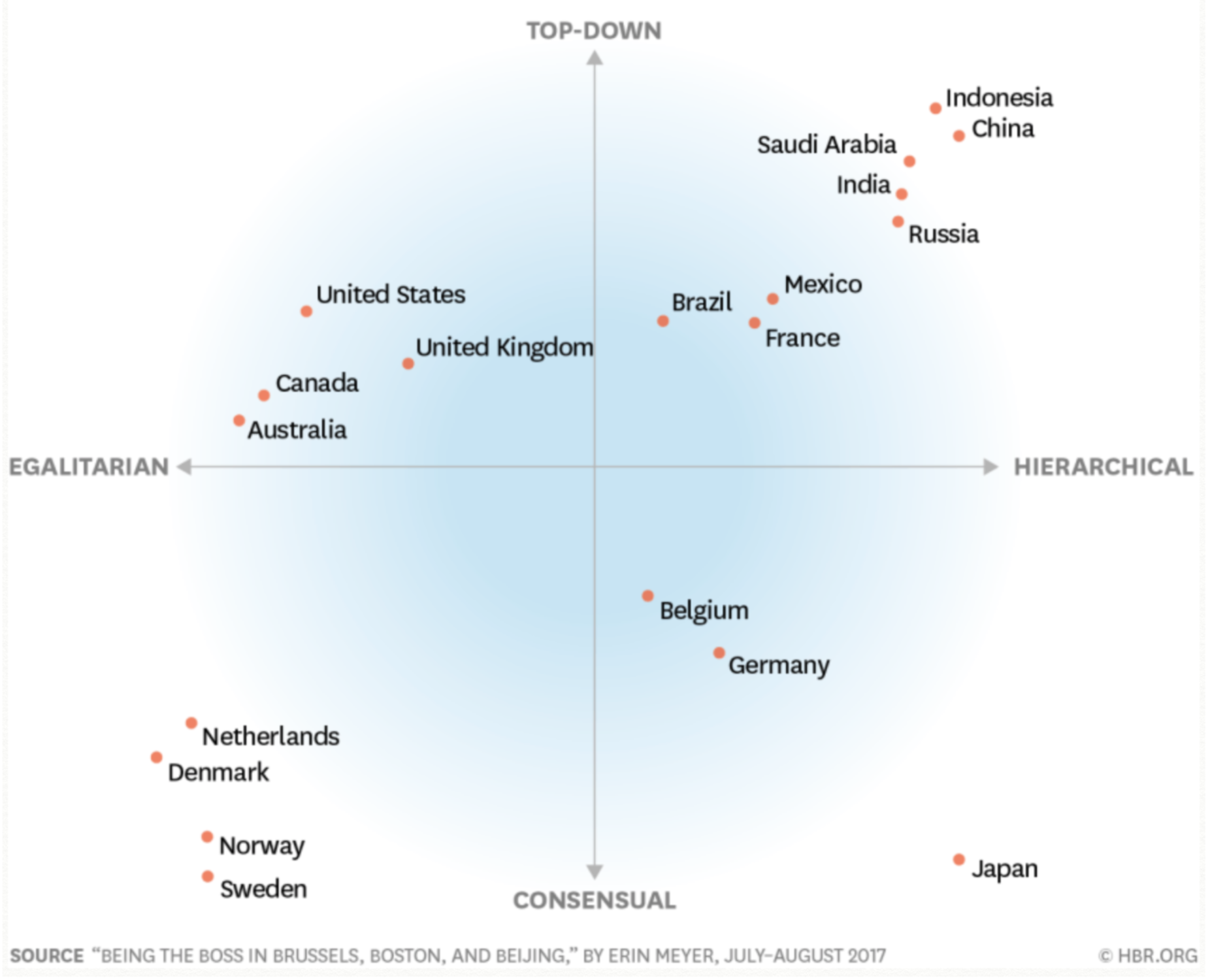
My reflection on this valuable piece of research is that, possibly just as this pandemic has miraculously brought all countries closer together in the face of the threat to our health, the proliferation of social media and digital culture has, over the last 20 years, fostered closeness between different cultures. In fact, nowadays it's easier to have a distributed team, since the challenge of country-culture has less of an impact on project management.
The proliferation of agile methodologies in project management, the rise of "digital product management" as a management discipline and methodology for pursuing project growth, along with the imposition (whether by trend or opportunity) of the success models of the big unicorns, may have brought millennials -and non-millennials- closer to a single style in which country-culture no longer has as much impact. It wouldn't surprise me if Erin Meyer reflects on these aspects in the book she'll publish this May together with Netflix's CEO.
Could it be that we're talking about generational cultures?
DIFFERENT GENERATIONS IN THE WORKPLACE
Let me do the same exercise, mapping generations across the different axes, to arrive at the reflection this post is about. In the following chart, following Erin Meyer's model, I've mapped different generations across the axes of authority and decision-making. Nothing less scientific than my own observational judgment.
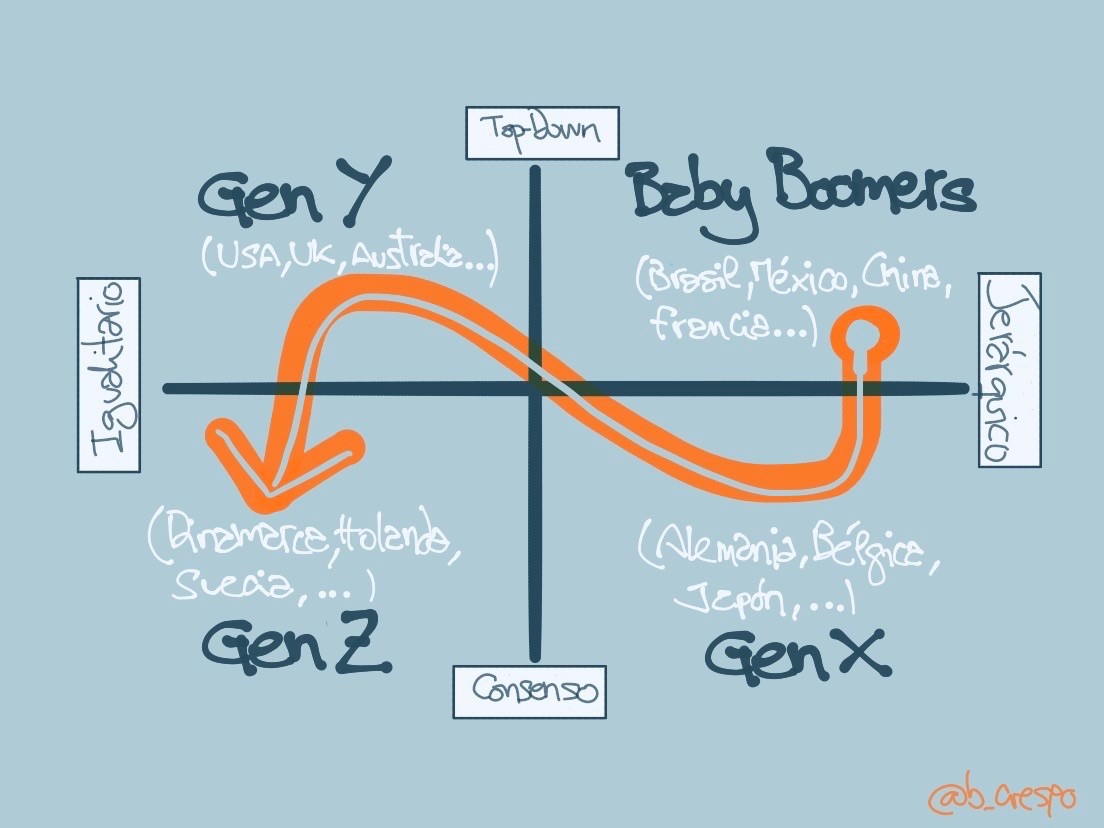
Possibly the different generations in the same workplace fall into patterns similar to those established for country-culture, and now we have to figure out what leadership style to use depending on the generation we happen to be managing / facilitating:
- Baby boomers: Accustomed to hierarchy as a chip embedded since birth. And enactors of decision-making models shaped by the charisma of the unquestionable leader.
- Generation X: Worn out by the unquestionable-leader model and marked by a meta-message of "your effort will be rewarded." And then I'll be the boss.
- Gen Y - Millennials: Lovers of egalitarian decision-making models, but at the same time arrogant and full of themselves because of the disillusionment previous generations left them as a working environment. When they grow professionally, their arrogance in decision-making surfaces.
- Gen Z - Centennials: Born into egalitarian, utopian decision-making models and marked by the chip of consensus, cooperation, and collaboration as a learned success model.
Nowadays we have to coexist with these four generations in the same work environment, and it's probably worth drawing on Meyer's findings for a more effective management model. And what happens in environments or contexts of absolute crisis?
THE ACCEPTANCE MODEL AND THE ARROGANCE MODEL
Whichever model we choose, there will always be contexts in which the leadership style is determined not by a generational component but by the need to impose a solution above consensus. The lockdown and (almost global) isolation measures are a clear top-down exercise. In these contexts there's no room for egalitarian decision-making — but there is room for the power of consensus when it comes from accepting a rock-solid reality. The group doesn't decide, and, the group determines the success of the strategy.
The author
Bernardo Crespo
C-suite advisor in AI, data and strategy. CEO of Quantum Markethink and Academic Director at IE. He helps leadership teams make sound decisions in the age of AI.
LinkedIn